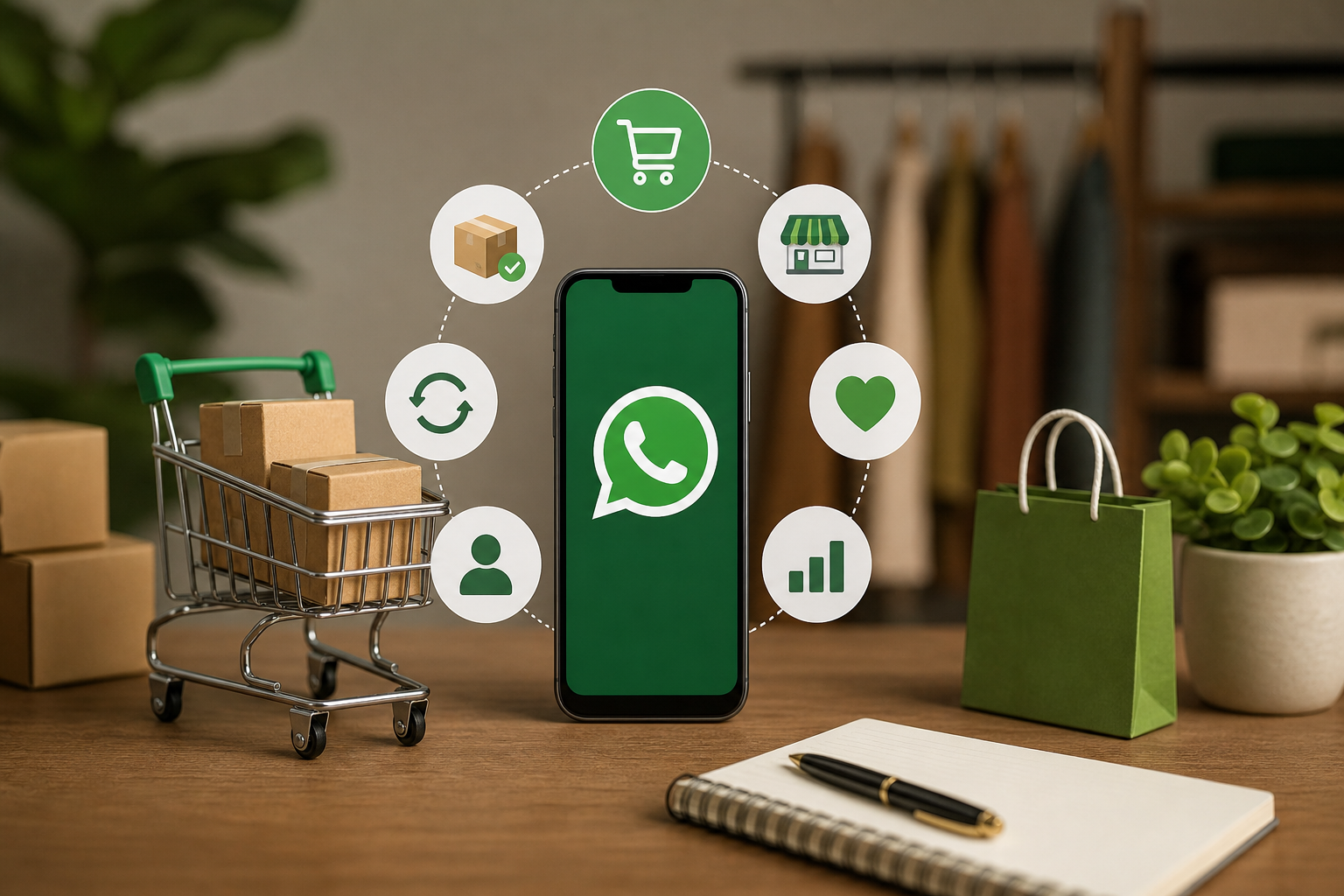
A practical guide to using WhatsApp after the first purchase—covering compliant messaging, customer segments, replenishment journeys, cart boundaries and measurement for Indian ecommerce teams.
Many Indian ecommerce brands work hard to win a first order and then become silent. The customer receives an invoice, perhaps a delivery notification, and no useful reason to return. When the brand eventually sends a broad WhatsApp broadcast, it often promotes products the customer does not need, arrives too frequently or ignores whether the previous order was delivered successfully.
WhatsApp marketing for ecommerce in India works better as a retention system than as a daily promotion channel. Its role is to make the next purchase timely and relevant: confirm the order, reduce uncertainty, support product use, remind the customer when replenishment is likely, and offer a sensible next product when there is a genuine fit.
This requires more than a WhatsApp number and a list of customers. You need clear consent, customer data that can be trusted, message rules, suppression processes and measurement that connects conversations to completed repeat orders.
Why WhatsApp belongs in an ecommerce retention strategy
WhatsApp is useful after purchase because it can support several moments in the customer journey:
- Order confirmation and delivery communication can reassure the customer that the purchase is progressing.
- Product-use guidance can help the customer get value from the order.
- Replenishment reminders can appear close to the likely time of need.
- Complementary-product messages can build a relevant second basket.
- Win-back messages can re-engage customers who have stopped buying.
- Support conversations can resolve problems before dissatisfaction becomes a lost customer.
However, WhatsApp is not automatically a high-performing channel. A message can be delivered and read without creating a profitable order. Some customers may prefer email, app notifications or SMS. Others may welcome order updates but not promotional messages. Treating every customer as equally reachable is one of the fastest ways to reduce trust.
The practical objective is not to maximise messages. It is to create a controlled journey in which each message has a clear customer benefit and a measurable commercial purpose.
Define the customer journey before choosing campaigns
Start with the events that already exist in your ecommerce system. A basic retention journey can look like this:
- Permission: the customer chooses whether to receive WhatsApp communication and understands what type of communication it covers.
- Purchase: the order is confirmed with product, payment and delivery details.
- Fulfilment: dispatch, tracking or delay updates are sent when relevant.
- Delivery: the brand checks whether the order was successfully delivered or needs support.
- Adoption: the customer receives useful instructions, care advice or usage information.
- Repeat-purchase window: the brand sends a replenishment or related-product message when the timing makes sense.
- Retention or win-back: customers are treated differently based on their order history and recent engagement.
This structure prevents a common mistake: sending a discount immediately after delivery when the customer has not yet used the product. A post-purchase message should first help the customer succeed. A commercial message becomes more credible when it follows a useful experience.
Consent and messaging boundaries in India
Consent should be captured in plain language, not hidden inside a lengthy checkout statement. Explain who will message the customer, the broad purpose of the messages and how the customer can stop promotional communication. Keep a record of the consent event, including the source, time and wording shown.
For example, a checkout choice could distinguish between:
- Essential order and delivery updates.
- Customer support communication.
- Product recommendations, offers and other promotional messages.
Do not assume that a customer who shared a phone number for delivery automatically wants frequent marketing. Your exact approach should be reviewed against applicable Indian privacy, telecom and platform requirements, as well as the current WhatsApp Business policies and template rules.
Every promotional message should identify the business clearly and provide a simple way to opt out. An instruction such as “Reply STOP to stop promotional messages” is easier to understand than an obscure preference-centre link, although the process behind it must actually update the suppression list.
Maintain a central suppression record. It should apply across broadcasts, automated journeys, CRM exports and agency-operated campaigns. If a customer opts out, do not allow an old spreadsheet or a separate store integration to add that person back automatically.
A useful rule is to separate the permission to receive service communication from the permission to receive marketing communication. This makes both customer experience and internal governance clearer.
Use transactional updates to build trust, not to disguise promotions
Order messages are often the first WhatsApp interaction after purchase. Keep them focused on the service event. Include the order number, product summary, delivery status, expected timing and an easy support route where appropriate.
Do not turn every order confirmation into a sales flyer. A small related suggestion may be acceptable in some systems, but it should not obscure the information the customer needs. Transactional messages and promotional campaigns should have separate templates, triggers, reporting and ownership.
Useful service journeys include:
- Confirmation after a successful order.
- Payment-failure guidance without creating a duplicate order.
- Dispatch and tracking updates.
- Delay or exception notifications.
- Delivery confirmation and support instructions.
- Return, refund or replacement updates.
Suppress promotional messages while an order is delayed, under investigation, refunded or involved in an unresolved support issue. Sending a “buy again” message while the customer is still complaining about the first order can damage trust and create additional work for the support team.
Create replenishment journeys based on product behaviour
Replenishment is usually more useful than a generic “shop now” broadcast, but it must reflect how the product is consumed. A household cleaning product, skincare item, pet-care product and packaged food item may all have different usage cycles.
Use historical order data to estimate a reasonable reminder window. Do not present the estimate as a certainty. A message such as “You may be running low” gives the customer room to decide, while “Your product has finished” may feel presumptuous.
A replenishment journey can follow this sequence:
- Identify the last delivered order and its product quantity.
- Estimate a reminder window using repeat-order intervals for similar customers.
- Exclude customers with refunds, failed delivery, recent support complaints or a newer order.
- Send one useful reminder with the previous product and a direct purchase path.
- Send a limited follow-up only if the customer has not purchased or opted out.
- Stop the journey when a new order, click-based exclusion or support event indicates a change.
For products with variable consumption, let customers choose a reminder preference such as monthly, every two months or “remind me later”. This creates better data than repeatedly guessing for them.
Segment customers before sending repeat-purchase campaigns
Segmentation turns WhatsApp from a broadcast tool into a customer-lifecycle channel. At minimum, create segments using the following fields:
| Segment signal | How it can guide messaging |
|---|---|
| Product category | Show relevant replenishment or complementary items instead of the full catalogue. |
| Recency | Separate recent buyers, customers near their expected reorder window and lapsed customers. |
| Frequency | Recognise one-time buyers, occasional buyers and regular customers with different journeys. |
| Customer value | Test service benefits, bundles or early access without assuming that every customer needs a discount. |
| Location | Account for delivery coverage, local stock, regional offers and realistic delivery promises. |
| Engagement | Distinguish people who click or respond from those who have ignored recent messages. |
| Order status | Suppress customers with failed, refunded, returned or unresolved orders. |
Location can be important in India because fulfilment times, serviceability, language preferences and stock availability may differ across pincodes. Use location only when it improves relevance and handle customer data carefully.
Start with a few operationally reliable segments rather than creating dozens that nobody maintains. A practical first version might include recent purchasers, replenishment-ready customers, high-frequency customers, lapsed customers and customers with an open support issue.
Set firm rules for abandoned-cart reminders
Abandoned-cart messaging can recover demand, but it should not become an excuse to message anyone who visited a product page. A cart reminder needs a known cart event, a customer identity, a suitable permission basis and a product that is still available.
Define these rules before activating the journey:
- Wait long enough for the customer to complete payment without pressure.
- Send the first reminder only after the cart has remained inactive for a defined period.
- Limit the number of reminders for one cart.
- Stop the sequence immediately after purchase, opt-out or support contact.
- Exclude customers who have recently purchased the same product.
- Do not promote an item that is out of stock, materially changed in price or unavailable for the customer’s location.
- Avoid adding a discount automatically; first test a simple reminder against an incentive.
Keep cart reminders distinct from post-purchase retention. A person who has just completed an order should not receive an old cart reminder later because the systems failed to reconcile the purchase.
Design repeat-purchase campaigns around a clear reason to return
There are four useful campaign types for most ecommerce brands:
Replenishment prompts
Use these when the customer is likely to need the same product again. Show the previous item, pack size and purchase path. If the customer commonly changes pack size, test a choice rather than forcing the old configuration.
Complementary products
Recommend products that make the original purchase more useful. A phone case may be relevant after a phone purchase, but a completely unrelated category may not be. Base the recommendation on product relationships, not on the entire catalogue.
Limited offers
Use offers selectively for a defined business reason, such as clearing a seasonal range or encouraging a second order. Set an expiry and explain the benefit clearly. Frequent discounts can train customers to delay purchases and reduce margin.
Lapsed-customer win-backs
First identify why the customer may have lapsed. A one-time gift purchase should not be treated like a regular consumable order. Test a helpful product reminder, new-arrival message, feedback request or service-led reactivation before assuming that a price cut will solve the problem.
Choose the right WhatsApp setup
The WhatsApp Business app may be sufficient for a small catalogue and manual customer conversations. It becomes difficult to govern when you need automated templates, order-status triggers, multiple agents, segmentation, opt-out controls and revenue reporting.
An API-based setup can connect WhatsApp with an ecommerce platform, CRM, customer-support system and analytics tools. Before selecting a provider, check:
- How customer consent is stored and passed to the messaging system.
- Whether approved templates can be managed by purpose and language.
- How opt-outs and suppression lists are synchronised.
- Whether order, refund and support events can trigger exclusions.
- How replies are assigned to teams and recorded in the CRM.
- Whether message delivery, clicks and purchases can be exported.
- How pricing works for service and marketing conversations.
- What happens when a customer replies outside the automated flow.
Do not buy a platform simply because it promises bulk messaging. First document the audience rules, consent workflow, event triggers and reporting requirements. A more expensive system can still produce poor results if the underlying order and customer data is incomplete.
Measure the funnel from message to repeat revenue
Track more than delivery and click rates. A useful retention funnel includes:
- Eligible customers.
- Messages sent and delivered.
- Reads or other available engagement signals.
- Replies and support interactions.
- Clicks to the product or cart page.
- Completed orders.
- Net revenue after discounts, returns, refunds and cancellations.
- Repeat-order rate within a defined period.
Use consistent campaign identifiers and UTM parameters in links. Pass the customer or order reference into your ecommerce and CRM systems where appropriate, while limiting access to personal data. Coupon codes can help identify campaign orders, but they are not perfect: customers may share codes, use them after seeing another channel or buy without applying them.
Report revenue at customer and cohort level. For example, compare customers who entered a replenishment journey with similar customers who were eligible but held out during the same period. This helps distinguish incremental orders from purchases that would have happened anyway.
Be careful with attribution. If a customer clicks a WhatsApp message after seeing an email and then buys through a bookmarked website, assigning the full sale to WhatsApp may overstate its impact. Review last-click, assisted-conversion and holdout results together.
Build an operating checklist
Before launch, confirm the following:
- Consent wording is understandable and stored with source and timestamp.
- Transactional and promotional templates are separated.
- Business identity and opt-out instructions are clear.
- Suppression lists work across every sending system.
- Recent buyers, refunds, returns, failed deliveries and open complaints are excluded where relevant.
- Frequency caps apply across campaigns, not only within one journey.
- Stock, price, delivery and product links are checked automatically or through a defined review process.
- Replies reach a trained support or sales owner.
- UTMs, coupon rules and order matching are documented.
- Templates are tested in the languages and devices used by your customers.
- A monthly review covers revenue, margin, opt-outs, complaints, repeat orders and incremental lift.
Frequency caps should be decided by customer segment and message type. A service update does not have the same purpose as a promotional broadcast, but customers still experience all messages from the brand together. If a customer has received several promotional messages without engaging, reduce or pause marketing rather than increasing the frequency.
When WhatsApp is not the right retention channel
WhatsApp may not be appropriate when customers have not given suitable permission, when the product has a long and unpredictable replacement cycle, or when your support team cannot handle replies. It is also a poor substitute for fixing delivery delays, product quality issues, confusing checkout or weak post-purchase service.
Use channels together according to their strengths. Email can support detailed product education and receipts. SMS can handle concise, time-sensitive alerts. Push notifications can work well for customers who actively use your app. Onsite personalisation can support returning visitors without sending another message. WhatsApp is most valuable when it adds timely, conversational utility rather than duplicating every channel.
Conclusion
For Indian ecommerce brands, WhatsApp marketing for repeat purchases should begin with customer permission, reliable order data and a small number of useful journeys. Start with order updates and support exclusions, then add one replenishment journey for a product category with a reasonably predictable buying cycle. After that, test a relevant cross-sell or win-back campaign against a holdout group.
Before choosing a provider or increasing message volume, document consent, segments, suppression rules, frequency caps, template purposes and revenue measurement. Review performance using repeat orders, net revenue, margin and opt-outs—not clicks alone. The realistic next action is to audit your last 90 days of orders, identify one repeat-purchase opportunity and build a controlled pilot that customers can easily understand and leave.
About Sanat Haldar
Sanat Haldar is a digital marketing consultant and website developer based in Kolkata, working across SEO, Google Ads, Local SEO, performance marketing and conversion-focused websites. For businesses working on Google Ads services, the relevant service page explains the approach, scope and next steps.