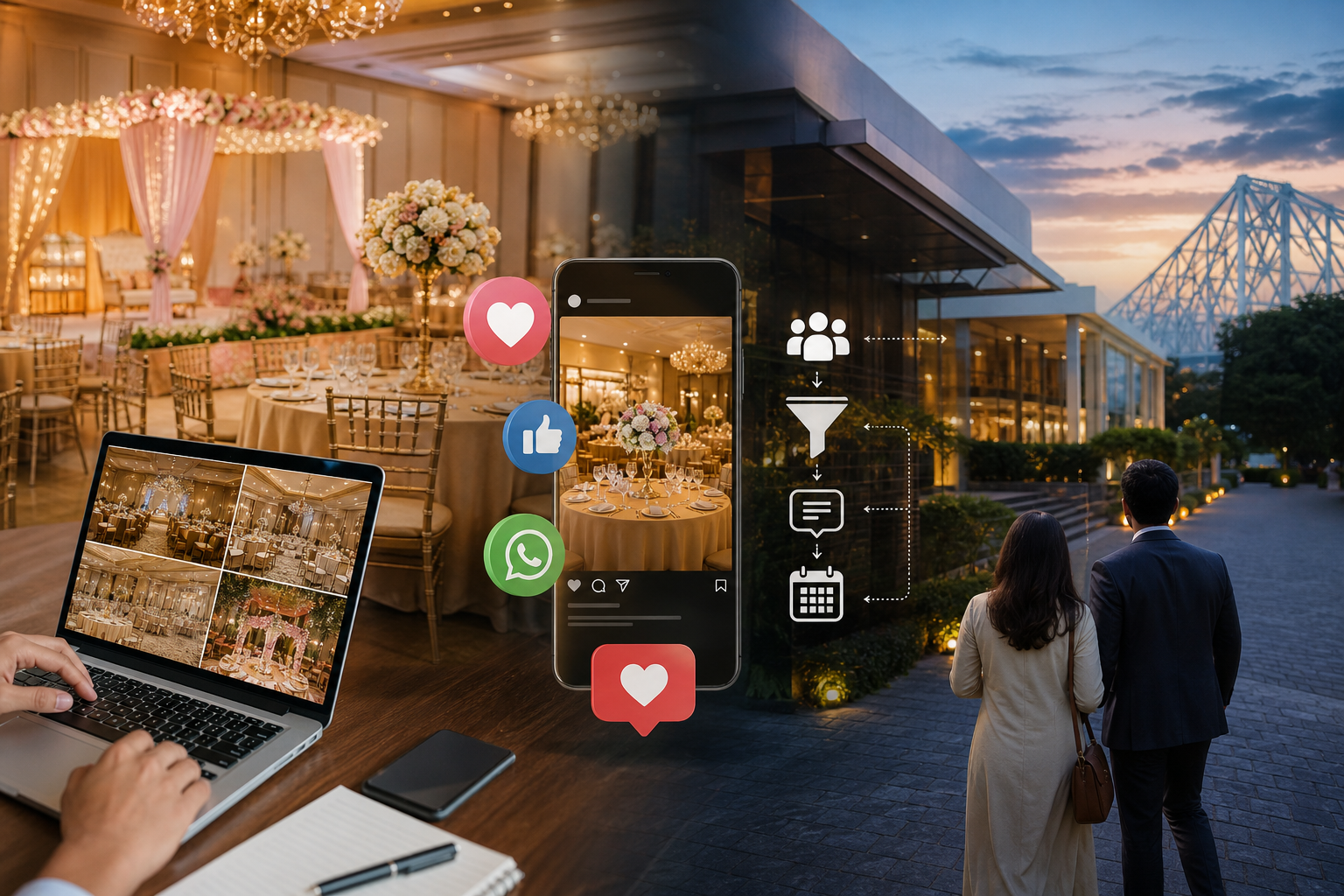
For Kolkata hotels and wedding venues, social media success is not measured by reach alone. The right strategy must show the venue convincingly, attract suitable event enquiries, qualify dates and budgets, and move prospects from Instagram or Facebook to a site visit.
A hotel or banquet hall in Kolkata can receive plenty of likes, video views and profile visits without receiving a single serious booking enquiry. This usually happens when social media is treated as a display window rather than part of the sales process.
Event buyers are not only asking whether a venue looks attractive. They want to know whether it is available on their date, suitable for their guest count, reachable for relatives, comfortable for elderly guests, flexible with décor, clear about food and capable of handling the event properly. A polished Reel may create interest, but practical proof and organised follow-up are what move that interest towards a site visit.
For hotels and banquet halls, social media marketing in Kolkata should therefore be planned around qualified enquiries, conversations, site visits and bookings—not visibility alone.
Why visibility alone does not fill a Kolkata venue
A hospitality business may have several different revenue priorities at the same time. A hotel may promote rooms, restaurants, conferences and weddings. A banquet hall may focus on receptions, birthdays, anniversaries, social functions or corporate gatherings. Each audience has a different need, budget, decision-maker and buying timeline.
A wedding family may shortlist venues months in advance and compare several properties before visiting. A company may need a conference venue quickly but require an invoice, audio-visual support and seating flexibility. A family planning an anniversary may make a faster decision but still want to inspect parking, food arrangements and the hall’s atmosphere.
One generic content plan cannot address all these situations. A post showing flowers and stage lighting may attract attention, but it does not answer the questions that determine whether the venue belongs on a shortlist:
- What type of event is the space suitable for?
- How many guests can it accommodate in different seating layouts?
- Which dates or seasons are available?
- What is included in the package?
- Is outside catering or décor permitted?
- Are rooms, parking, lifts, washrooms and service areas adequate?
- How easily can the family or organiser visit the property?
Social media should help a prospect make these decisions progressively. It should attract the right person, provide enough evidence to ask an informed question and make the next step simple.
Map the journey from discovery to site visit
The typical journey begins when someone sees a wedding setup, searches for venue ideas or receives a recommendation on Instagram or Facebook. At this stage, the person may not yet be ready to enquire. They are collecting options and forming an initial impression.
The next stage is shortlist formation. Prospects view the profile, save posts, check highlights, watch walkthrough videos and compare the venue with alternatives. They then ask about a date, guest capacity, package, menu or availability. The conversation may happen through Instagram messages, Facebook, WhatsApp or a phone call.
The sales process continues after the first enquiry. The venue team must confirm requirements, share relevant information, handle objections, offer site-visit slots and record the next follow-up. A site visit may lead to a quotation, negotiation and booking, but only if the enquiry reaches someone responsible for event sales.
For this reason, the social media funnel should be designed as follows:
- Discovery: Reach people interested in weddings, events, accommodation or corporate gatherings.
- Shortlisting: Show credible venue proof and explain the event fit.
- Enquiry: Invite a clear action such as checking a date or requesting a package.
- Qualification: Capture the event requirements before a sales conversation.
- Site visit: Offer practical appointment slots and prepare the right information.
- Booking: Track the quotation, decision stage and outcome.
Define audiences and offers by event type
Begin with separate content and campaign groups rather than promoting every service to everyone. The main groups may include weddings and receptions, pre-wedding functions, birthdays and anniversaries, corporate meetings, conferences, room bookings and restaurant-led occasions.
For weddings, useful messages may include hall capacity, stage options, décor flexibility, guest rooms, catering, bridal or family requirements and the ease of arranging multiple functions at one property. For corporate events, focus on seating layouts, meeting equipment, Wi-Fi, parking, food service, billing and access for participants.
For smaller social functions, show how the venue handles a more intimate gathering. A family looking for a birthday or anniversary venue may not want a large wedding hall. Showing different room sizes and layouts helps the prospect judge suitability without making an unnecessary enquiry.
Each campaign or content series should have one primary action:
- Check availability for a preferred date.
- Request the wedding or event brochure.
- Ask for a package based on guest count.
- Schedule a venue visit.
- Speak to the events team about a corporate requirement.
“DM us” is easy to publish but weak as a sales instruction. A specific action helps both the prospect and the venue team understand the purpose of the conversation.
Build a venue proof system, not just a gallery
High-quality photographs are important, but attractive décor alone does not prove that a venue is suitable. A useful content library should answer practical questions through repeated, honest demonstrations.
Show the same hall in more than one setup: a traditional wedding, a reception, a conference, a birthday or a relatively open layout. Include wide shots that show movement and usable floor space, not only close-ups of flowers and table arrangements. If a setup is created for a particular event, make it clear when the image is illustrative rather than a standard package inclusion.
Important proof areas include:
- Hall size and guest capacity for different layouts.
- Stage dimensions, seating arrangements and décor flexibility.
- Entrance, lift access, parking and approach roads.
- Guest rooms, washrooms and areas for changing or resting.
- Catering counters, kitchen or service access and dining arrangements.
- Sound, lighting, screens and other available event facilities.
- How the team manages movement between ceremony, dining and reception areas.
- Real transitions before, during and after an event.
Walkthrough videos can be especially useful because they give viewers a better sense of scale and flow. However, the video should not hide important limitations through tight framing or excessive editing. Accurate information creates better enquiries and reduces disappointment during the visit.
Use content pillars with a conversion purpose
A practical monthly plan can combine several content pillars, each serving a different stage of the buying journey.
Venue walkthroughs and setup transformations
Use Reels to show the entrance, hall, dining area, rooms and event flow. A before-and-after transformation can demonstrate flexibility, while a simple walkthrough can help a prospect decide whether a visit is worthwhile.
Event-specific proof
Publish separate examples for receptions, haldi or mehendi functions, birthdays, conferences and other relevant events. The purpose is not to claim that every event will look identical. It is to help different audiences visualise how the space can be used.
Facilities, menus and service details
Explain what is included, what is optional and what needs separate confirmation. Discuss menu formats, vegetarian or non-vegetarian options where applicable, service style, parking, rooms, audio-visual facilities and décor coordination without making unclear package promises.
FAQs and objection handling
Answer questions about outside vendors, timing, advance booking, cancellation terms, music restrictions, power backup, accessibility, parking and rain-related arrangements if relevant. These posts often support serious prospects who are already comparing venues.
Availability prompts and site-visit invitations
Use Stories or posts to invite date checks and visits. Avoid implying that a date is available unless the events team has verified it. A prompt such as “Planning a December reception? Share your date and guest count for a package discussion” is more useful than a general promotional line.
Testimonials and event feedback
Use testimonials only with the required permission and present them in a specific manner. A comment about helpful coordination, food service or room convenience is more informative than an unexplained five-star graphic.
Give Instagram and Facebook different jobs
Instagram is well suited to visual discovery. Reels can show scale, movement, lighting and transformations. Carousels can explain capacity, facilities, sample layouts or a step-by-step venue visit. Stories can handle questions, reminders, polls and date-check prompts. Important information such as location, contact route, event categories and booking action should be easy to find through pinned content and highlights.
Facebook can support local discovery and sharing among family groups, community networks and event planners. Longer captions, event albums and enquiry-focused posts may be useful there. The exact mix should depend on where the venue’s actual enquiries originate, rather than on a fixed platform rule.
Do not make every post promotional. Discovery content earns attention, proof content supports comparison and action content creates the enquiry. A healthy plan gives each type a defined role.
Qualify enquiries before sales follow-up
A lead is not automatically a useful lead. Before sending a generic brochure or calling without context, capture enough information to understand fit. A simple form, WhatsApp opening message or receptionist script can ask:
- What type of event are you planning?
- What is the preferred date, or the date range?
- How many guests are expected?
- Which area of Kolkata is convenient for the family or organisation?
- What budget range or package level is being considered?
- Are rooms, catering, décor, parking or audio-visual facilities required?
- Would you like to visit the venue, and which days are convenient?
Budget questions need tact. A broad range or package preference is usually less intrusive than demanding an exact figure. The purpose is to recommend a suitable option and avoid wasting time on a clear mismatch.
Lead forms should not ask for unnecessary information. They should be short enough for mobile users but detailed enough to separate a date-qualified event enquiry from a casual request for photographs.
Connect social enquiries to WhatsApp, calls and a tracking sheet
Many venues lose leads between an Instagram message and the sales desk. Assign ownership for checking messages, calls and WhatsApp conversations. Define what happens when the usual contact person is unavailable.
A simple tracking sheet or CRM should record the source, campaign or post, enquiry date, event type, preferred date, guest count, budget range, response time, qualification status, follow-up date, site-visit status, quotation stage and final outcome. Use clear stages such as new, contacted, qualified, visit proposed, visit completed, quotation sent, won, lost or not yet decided.
WhatsApp is useful for sending a relevant brochure, package summary, directions, available visit slots and answers to questions. It should not become an unstructured stream of repeated messages. Confirm the prospect’s requirement first, send only relevant material and agree on the next action.
Calls are often important for detailed wedding discussions, but the caller should have the conversation history. Asking the prospect to repeat basic information creates friction and makes the venue appear disorganised.
Use paid social campaigns with tighter control
Paid campaigns should be separated by objective and audience. A wedding campaign can use wedding-related creative, venue proof and a date or package enquiry action. A corporate campaign should show meeting layouts, facilities, access, billing and event support instead of wedding décor.
Do not optimise only for cheap engagement. A video view or click can be useful for building a retargeting audience, but it is not equivalent to a qualified event lead. Campaigns should direct people towards a suitable WhatsApp conversation, enquiry form, call or landing point with enough context.
Retarget people who watched venue videos, interacted with key posts or visited relevant pages, but vary the message. Someone who has already seen the hall may need a package explanation or site-visit invitation rather than another general awareness video.
Campaign tracking should use consistent naming and source records. If the venue cannot identify which campaign produced an enquiry, it cannot properly compare lead quality or improve budget allocation.
Make follow-up part of the marketing system
The first reply should acknowledge the enquiry and confirm the requirements. The next message can share the most relevant proof: a wedding setup for a wedding enquiry, a conference layout for a corporate enquiry or a smaller-hall option for an intimate function.
A practical sequence may look like this:
- Confirm event type, date, guest count and key requirements.
- Share the relevant brochure, package information or venue video.
- Answer the main concern, such as parking, menu, rooms, décor or timing.
- Offer two or three specific site-visit slots.
- Send directions and confirm the appointment.
- After the visit, record the quotation stage and agree on the next follow-up date.
The sequence should be adapted to the prospect’s response. Repeated automated messages can feel impersonal, especially when families are making a high-value and emotionally important decision.
Measure commercial outcomes, not vanity metrics
Reach, likes and follower growth can indicate whether content is being distributed, but they do not show whether the venue is attracting suitable business. A more useful reporting view includes:
| Stage | Useful measure |
|---|---|
| Discovery | Relevant reach, video engagement and profile actions |
| Enquiry | Package requests, date checks, calls, forms and WhatsApp conversations |
| Qualification | Date-qualified leads, suitable guest counts and event-fit enquiries |
| Sales progress | Response time, visits proposed, visits completed and quotations sent |
| Commercial result | Bookings, lost reasons, booking value where recorded and source contribution |
Review lead quality by event category. A campaign producing fewer but more suitable wedding enquiries may be more valuable than a campaign producing a large number of vague messages. Also review why leads are lost: unavailable dates, budget mismatch, location, capacity, package expectations or slow follow-up.
Operating checklist for Kolkata venues
- Obtain consent before publishing identifiable guest images or testimonials.
- Keep capacities, package inclusions, timings and contact details accurate.
- Show the venue’s real location and explain access or parking honestly.
- Assign a person to respond to social enquiries during working hours.
- Use one shared lead record instead of separate, unconnected inbox notes.
- Record campaign source and enquiry stage consistently.
- Check that every public offer has a clear validity or availability condition.
- Review creative before publication for misleading scale, outdated décor or unavailable facilities.
- Train the sales team to continue the conversation with context from social media.
When should a venue use an agency?
An agency may be useful when the venue needs regular photography and video production, content planning, paid campaign management, lead tracking and coordination with the sales team. It is not enough for a provider to promise frequent posting or attractive Reels.
Before appointing one, ask how it will handle venue shoots, permissions, event-season planning, audience separation, WhatsApp or form workflows, lead-quality reporting and sales handoff. Confirm who responds to enquiries and who owns the tracking data. A provider that reports only impressions and engagement is not addressing the full commercial requirement.
In-house staff may manage the process effectively if they have access to the venue, can capture current content, understand packages and respond quickly. An external partner becomes more valuable when these capabilities are unavailable or when paid campaigns and measurement need specialist management.
Conclusion
Social media marketing for hotels and banquet halls in Kolkata works best when it helps a prospect move from visual discovery to a confident venue visit. The essential system combines event-specific content, honest venue proof, clear calls to action, sensible qualification, fast WhatsApp or phone follow-up and reporting tied to site visits and bookings.
Start with one event category, such as weddings or corporate meetings. Audit the current venue proof, create a short enquiry form, assign response ownership and track every lead through the first site visit. Once that workflow is reliable, add paid campaigns and more event categories. This gives the venue a practical basis for deciding what to scale—and what to stop—without confusing visibility with business results.
About Sanat Haldar
Sanat Haldar is a digital marketing consultant and website developer based in Kolkata, working across SEO, Google Ads, Local SEO, performance marketing and conversion-focused websites. For businesses working on Google Ads services, the relevant service page explains the approach, scope and next steps.