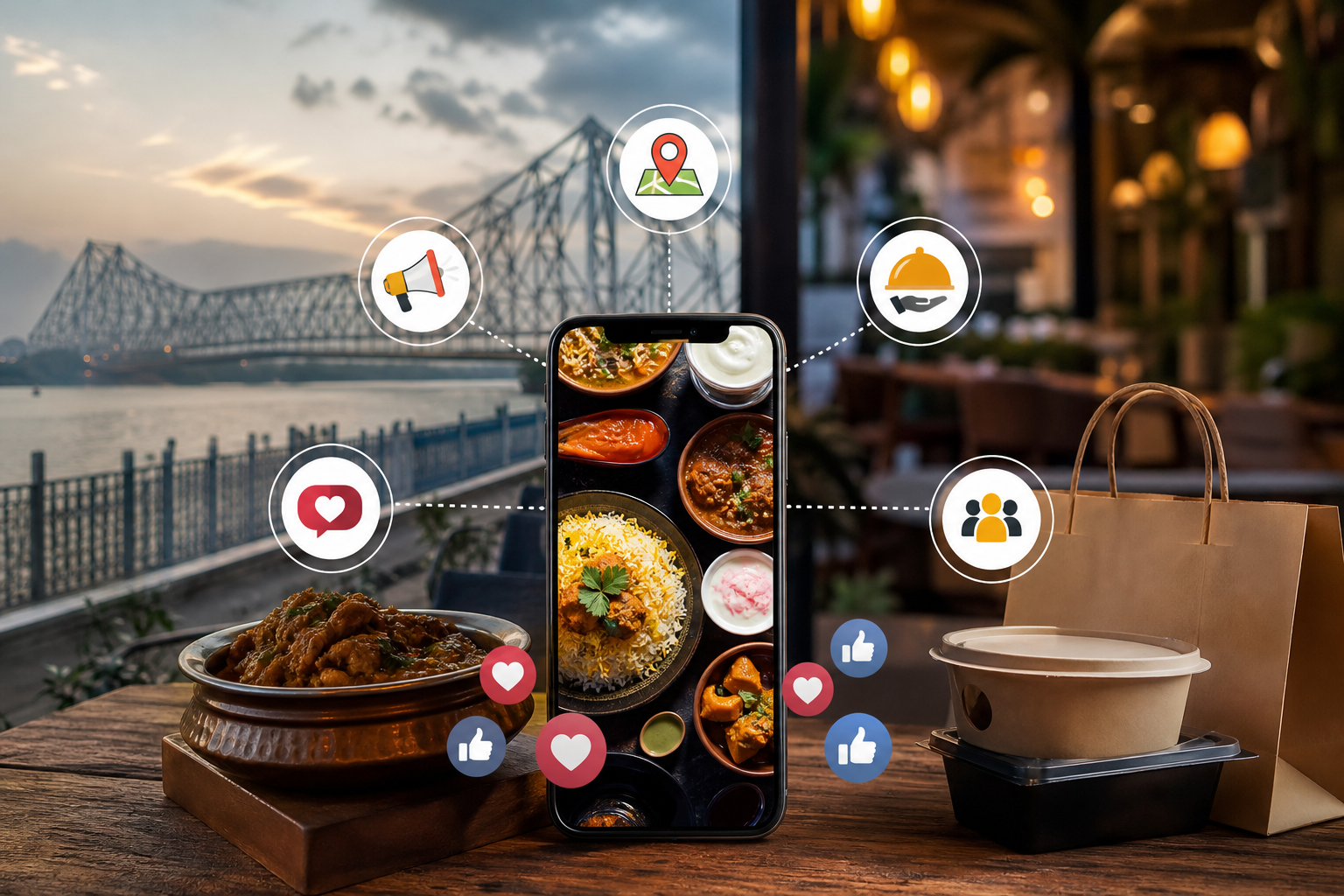
For a Kolkata restaurant, social media should do more than showcase attractive food photos. It should help nearby diners discover the venue, understand the experience, take a clear booking or ordering action, and return through relevant follow-up campaigns.
A restaurant can post attractive food photographs every day and still have empty tables on a Tuesday evening. The problem is usually not a lack of content. It is the gap between attention and action. A person may enjoy a biryani reel, but still not know where the restaurant is, whether it suits a family dinner, what the price range is, or how to reserve a table.
For restaurants in Kolkata, social media marketing should therefore be planned as a customer journey. Content must help a nearby diner discover the restaurant, decide whether it fits the occasion, take a booking or ordering action, and receive a relevant reason to return. Instagram and Facebook can support this journey, but only when the profile, content, paid campaigns, offers and follow-up process work together.
Why a full-funnel approach matters for Kolkata restaurants
Restaurant decisions happen at different levels of intent. Someone watching a short video of a new menu item may be casually exploring. Someone searching for a restaurant in a particular neighbourhood or messaging about table availability is much closer to visiting. Treating both people with the same post and the same call to action wastes the opportunity.
A useful restaurant funnel has four stages:
- Discovery: Introduce the food, atmosphere, location and personality of the restaurant.
- Consideration: Answer practical questions about cuisine, price expectations, ambience, timings, seating and suitability for an occasion.
- Conversion: Make it easy to reserve, order, call, message, get directions or claim a valid offer.
- Repeat visits: Give existing customers a reason to return through new menus, occasions, events, membership or carefully timed offers.
Each stage needs different creative. Discovery content should earn attention. Conversion content should remove uncertainty. Repeat-visit communication should be relevant rather than simply promotional.
Start with audiences and dining occasions
“People in Kolkata who like food” is too broad an audience for planning. A restaurant should identify the people it can serve profitably and the occasions that lead them to choose a venue.
Depending on the location and concept, audiences may include neighbourhood residents, office workers looking for lunch, families planning a weekend meal, couples choosing a date-night venue, students seeking affordable food, delivery customers and visitors searching for a particular cuisine or area. These groups may use the same platform, but their questions and triggers are different.
Build a simple audience-and-occasion table before producing content:
| Audience or occasion | Likely question | Useful content or action |
|---|---|---|
| Office lunch | Is service quick and is there a suitable lunch option? | Lunch menu, service timing and call-to-action for enquiry or order |
| Family meal | Is the seating comfortable and does the menu suit different preferences? | Seating, group portions, menu variety and reservation route |
| Date night | Does the ambience feel right and can a table be booked? | Atmosphere video, evening menu and booking button |
| Delivery customer | What travels well and how can it be ordered? | Packaging, recommended dishes and direct ordering link |
| Local searcher | Where is it and is it open now? | Area reference, landmark guidance, timings and map directions |
Do not force Kolkata references into every caption. Local relevance is stronger when it is useful: a nearby landmark, a neighbourhood delivery area, a Bengali festival menu, a monsoon dining idea or a genuine connection to local food preferences.
Build a discovery content system, not a random posting schedule
Discovery content should give people a reason to remember the restaurant. Food photography is important, but it should not be the entire system. A potential customer also needs to understand what makes the venue different and when they might visit.
Useful discovery content pillars include:
- Signature dishes: Show the dish clearly, explain what makes it distinctive and indicate whether it is available daily or for a limited period.
- Short-form preparation videos: Capture plating, grilling, baking or a final garnish. The aim is to show freshness and craft without making unsupported claims.
- Ambience and seating: Display the room in realistic lighting, including tables for couples, families or groups where relevant.
- People behind the food: Introduce the chef, service team or kitchen process when the restaurant is comfortable sharing it.
- Seasonal menus: Plan content around legitimate menu changes, festive periods and weather-related dining occasions.
- Local context: Mention the neighbourhood, nearby office zone, landmark or delivery area when it helps someone decide to visit.
- Customer questions: Turn recurring questions about spice level, reservations, parking, vegetarian choices or group seating into clear posts.
A shoot list makes this manageable. In one planned session, capture wide ambience shots, vertical videos of key dishes, menu close-ups, staff interactions, entrance signage and practical location visuals. This reduces the pressure to create something new from scratch every day.
Use Instagram for visual discovery and conversation, while keeping Facebook useful for local updates, menus, event information, community reach and audiences that already follow the business there. The platforms can share a core idea, but the caption, format and call to action should be adapted rather than duplicated mechanically.
Turn the profile into a local decision page
A social profile often receives visitors after they have seen a post, an advertisement, a recommendation or a shared story. If the profile is incomplete, the restaurant loses high-intent users even when the content performs well.
Check the following information regularly:
- Correct restaurant name, address and neighbourhood
- Opening hours, including changes for holidays or special events
- Clear cuisine and price cues where appropriate
- Current menu access without an outdated PDF or broken page
- Reservation instructions and a working booking route
- Ordering links for delivery or takeaway
- Phone number and WhatsApp contact option, if monitored
- Parking, entrance or landmark guidance where this genuinely helps
- Accurate profile and cover images that represent the current experience
Keep the path short. A diner should not have to search through several old posts to find the menu or booking instructions. Pin important information and update highlights or equivalent profile sections when menus, timings and offers change.
Use local intent in content and conversations
People do not always search using the restaurant’s name. They may describe an area, cuisine or occasion. Content can reflect these real decision patterns without becoming unnatural keyword writing.
Examples include posts about a particular cuisine near a relevant neighbourhood, a weekday lunch option for nearby offices, family dining during a festival period, or a dessert menu suitable for a group celebration. The content should provide actual information, not only repeat an area name.
Comments and direct messages are also local-intent signals. Questions such as “Do you take reservations?”, “Is there parking?”, “Can we bring children?”, “Is this available today?” or “Do you deliver to this area?” reveal what blocks a visit. Assign someone to answer these messages during defined hours. A fast, accurate reply is part of conversion, not merely customer service.
Prepare response guidance for recurring questions, but avoid sending robotic replies. Staff should know the current menu, timings, offer terms, booking process and escalation route when availability or complaints require a manager’s attention.
Give every campaign one primary action
One post can inform, entertain and show the brand, but a campaign should normally have one main action. Asking people to reserve, order, call, follow, share and visit a website at the same time creates confusion.
Choose the action according to intent:
- Reserve: Use for table availability, special menus and occasion-led dining.
- Order: Use for delivery, takeaway and dishes designed to travel well.
- Call or message: Use when customers need to ask about group bookings, events or custom requirements.
- Get directions: Use for local discovery campaigns where the main barrier is finding the venue.
- Claim an offer: Use only when terms, dates and redemption steps are easy to understand.
Match the destination to the promise. A post about a limited-time thali should lead to the current menu or reservation route, not a generic homepage. Test the links and phone numbers from a mobile device before publishing.
Use paid social selectively
Paid social can extend discovery and support demand during specific periods, but promoting every post is not a strategy. Start by deciding whether the campaign is for reach, engagement, reservations, orders, event attendance or repeat visits.
For a local restaurant, location targeting should reflect the practical area from which people can travel or receive delivery. A large audience may produce cheap engagement but little business value. Test a relevant Kolkata catchment area, then compare useful actions rather than judging only by views.
Retargeting is often more practical than repeatedly showing the same message to cold audiences. Depending on available consent and platform settings, audiences may include people who watched a significant part of a video, engaged with the profile, visited a booking page or interacted with an earlier offer. These people can receive a clearer conversion message, such as menu information, availability or a reservation reminder.
Separate creative by stage. A discovery video can focus on the dining experience. A retargeting advertisement can show the menu, date, offer terms and booking route. This distinction reduces the risk of asking an unfamiliar audience to make a decision before it understands the restaurant.
Design offers without weakening the brand
Discounts can create visits, but an uncontrolled offer may train customers to wait for a lower price or attract people who do not match the restaurant’s intended audience. Decide what business problem the offer is solving.
Possible structures include:
- A first-visit incentive for people who have discovered the restaurant but have not yet booked
- A weekday or off-peak offer to use available capacity
- A group dining package with clear inclusions and exclusions
- A seasonal menu or limited-time experience that creates urgency without a deep discount
- A delivery bundle for selected products and service areas
State the validity period, applicable days, minimum order or booking conditions, exclusions and redemption method. If the offer requires a code, train the front desk or order-processing team to record it consistently. Otherwise, marketing cannot distinguish genuine redemptions from ordinary visits.
Plan repeat visits with permission and segmentation
Acquiring a new diner is only part of the opportunity. A satisfied customer may return for a different occasion, but the restaurant needs a useful reason and an appropriate reminder.
Segment follow-up communication where possible:
- Dine-in customers can receive new-menu or occasion-led updates.
- Delivery customers can receive messages about suitable bundles, ordering windows or new delivery items.
- Group-booking customers may be interested in celebrations, private dining or advance reservations.
- Customers who opted into birthday or occasion communication can receive timely, clearly explained reminders.
Use permission-based channels and provide a simple way to stop promotional messages. A post-visit thank-you can ask for feedback, invite a review through an appropriate channel, or explain how to hear about future menus. Avoid sending every audience the same discount every week; frequency and relevance affect trust.
A practical monthly operating workflow
A small restaurant team can create a workable system with a monthly planning meeting and a weekly review.
- Set the business priorities: Choose the month’s focus, such as weekday occupancy, a seasonal menu, delivery growth or group bookings.
- Choose content themes: Select discovery, practical information, conversion and repeat-visit topics.
- Prepare a shoot list: Include dishes, ambience, staff, menu details, entrance and location visuals.
- Confirm the conversion path: Check booking links, ordering pages, WhatsApp, phone handling and offer terms.
- Publish and respond: Assign ownership for comments and messages, including weekends or peak enquiry periods.
- Review weekly: Record useful actions, customer questions, offer redemptions and operational issues.
- Improve the next cycle: Keep themes that lead to meaningful actions and change creative that attracts attention without visits or orders.
Keep a shared calendar with the post date, objective, audience, offer, call to action, landing destination, approval status and responsible person. This is more useful than measuring success by how busy the feed looks.
Measure restaurant outcomes, not only vanity metrics
Likes and reach can indicate attention, but they do not show whether social media is supporting restaurant revenue. Establish a baseline from the restaurant’s own data and track changes consistently.
Useful measures include:
- Profile visits and menu clicks
- Calls, WhatsApp enquiries and direction requests
- Reservation enquiries and completed bookings attributed to social activity
- Orders from tracked links or platform reports
- Offer codes or campaign-specific redemptions
- Video viewers and engaged audiences available for retargeting
- Repeat engagement and responses from existing customers
- Cost per useful action for paid campaigns
Use separate tracking links or codes for major campaigns, and ask the booking or front-desk team how the customer heard about the restaurant. This will not produce perfect attribution, but it is better than assuming every booking came from the last-click platform report.
When specialist support is useful
A restaurant may need outside social media marketing support when the owner or team cannot consistently plan content, produce usable creative, answer enquiries, manage paid campaigns or connect activity with bookings and orders. The right scope depends on the actual gap.
Support may include strategy, content production, social media management, community responses, paid campaign setup, retargeting, conversion tracking or monthly optimisation. Ask a provider to explain the operating process, approval responsibilities, response coverage, reporting method and the business actions being measured. Avoid choosing only on the promise of frequent posts or large follower numbers.
A realistic 30-day starting plan
Do not begin with every platform, offer and audience at once. Run a focused 30-day test:
- Select one discovery theme, such as signature dishes and ambience.
- Select one conversion objective, such as reservations for a weekday or a specific menu.
- Define one relevant Kolkata audience based on location and dining occasion.
- Prepare a complete booking, ordering or enquiry path before promotion begins.
- Publish a small set of discovery and conversion creatives with distinct messages.
- Retarget engaged users with practical information and a clear action.
- Record profile actions, enquiries, bookings, orders and redemptions.
- Contact recent customers through an approved follow-up method with a relevant next-visit reason.
Conclusion
Social media marketing for restaurants in Kolkata should not be judged by how often the restaurant posts or how attractive the feed appears. Its commercial value comes from connecting local discovery with clear decisions, measurable actions and repeat visits.
Start by choosing one audience, one dining occasion and one business objective. Improve the profile, create content that answers real customer questions, connect every campaign to one action, and record the resulting enquiries or bookings. After 30 days, use the restaurant’s own data to decide what deserves more budget, better creative or a different offer. If consistent execution, tracking or campaign management is beyond the internal team, evaluate specialist support against these practical requirements rather than against posting volume alone.
About Sanat Haldar
Sanat Haldar is a digital marketing consultant and website developer based in Kolkata, working across SEO, Google Ads, Local SEO, performance marketing and conversion-focused websites. For businesses working on Google Ads services, the relevant service page explains the approach, scope and next steps.