Google Business Profile is one local search asset. Local SEO is the wider system that supports visibility across Maps, organic results, your website and local directories. Understanding the difference helps you spend…
Many local businesses treat Google Business Profile and local SEO as interchangeable. They are not.
Your Google Business Profile is the business listing that can appear in Google Maps and the local results panel. Local SEO is the broader work of making your business visible and credible across local search: your profile, website, location pages, reviews, business directories, local references and technical signals.
The distinction matters because a business can have a well-filled-out profile but a weak website, or a technically sound website but an incomplete or poorly managed Maps presence. In both cases, the business may be missing relevant searches.
The practical answer is usually not “Google Business Profile or local SEO.” It is deciding which part needs attention first, then connecting the two so they reinforce the same business information and customer experience.
What is Google Business Profile?
Google Business Profile is a free Google-managed listing for an eligible business. It can show information such as:
- Business name, category and description
- Address or service area
- Phone number, website and opening hours
- Photos, services and products where applicable
- Customer reviews and business responses
- Updates, offers or other profile posts
- Questions and answers, depending on the profile and search experience
Its main job is to help Google and potential customers understand a local business at the moment of search. A person searching for “dentist near me,” “AC repair in Salt Lake” or “aesthetic clinic near Ballygunge” may encounter profile information before visiting a website.
That makes the profile valuable for discovery and action. A searcher may call, request directions, visit the website or read reviews without going further into a traditional search result.
However, a profile is still one property within your local search presence. Completing it does not automatically create strong visibility for every service, neighbourhood or search term.
What does local SEO include?
Local SEO is the wider process of improving a business’s visibility for geographically relevant searches. It can include:
- Google Business Profile management: accurate categories, services, hours, photos, updates, review responses and profile health.
- Website optimisation: clear service pages, location relevance, useful contact information, internal linking, mobile usability and technical accessibility.
- Local content: pages and resources that answer genuine questions from customers in the areas served.
- Citations and directory consistency: accurate business details across relevant platforms and local directories.
- Reviews and reputation: a compliant process for earning genuine customer feedback and responding constructively.
- Local authority: relevant mentions, partnerships, community references and links where they are earned naturally.
- Measurement: tracking calls, direction requests, form submissions, organic visits, profile interactions and qualified enquiries.
Local SEO therefore reaches beyond the profile. It supports both the map-based local results and the organic results that appear below or beside them.
Google Business Profile vs local SEO: the central difference
| Area | Google Business Profile | Local SEO |
|---|---|---|
| What it is | A business listing managed through Google | A broader visibility and relevance strategy |
| Main surfaces | Google Maps and local business results | Maps, organic search, websites, directories and local references |
| Primary purpose | Help searchers find and contact a local business | Build discoverability, relevance, trust and conversion across local search |
| Typical work | Categories, hours, services, photos, reviews and profile updates | Profile work plus website, content, citations, technical SEO and reputation activity |
| Control | Subject to Google’s profile rules and features | Depends on several platforms, your website and external signals |
| Best suited to | Businesses needing stronger Maps visibility and direct actions | Businesses targeting multiple services, locations or more competitive searches |
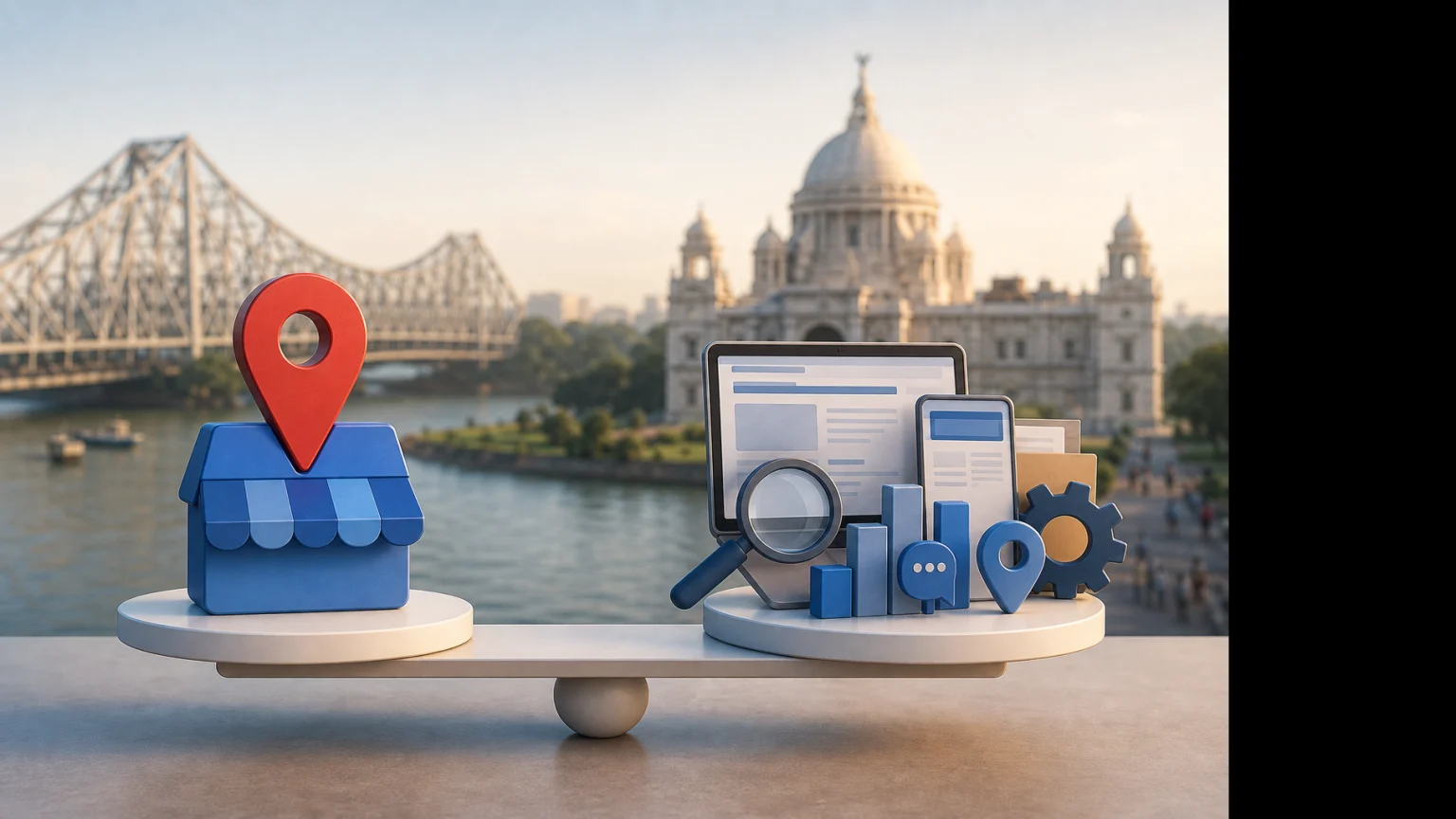
A useful way to think about it is this: Google Business Profile is a local search asset; local SEO is the operating system that supports your local visibility across several assets.
Why the distinction affects your marketing decision
Suppose a neighbourhood salon has no verified profile, incorrect opening hours and only a few customer reviews. A full website redesign may not be the first priority. Fixing the profile, confirming the category, adding accurate services and creating a reliable review process could address more immediate customer friction.
Now consider a multi-location diagnostic centre with accurate profiles but weak service pages, inconsistent location information and no useful explanation of its tests. Profile updates alone are unlikely to support searches for specific services across different areas. The business needs a broader local SEO programme.
The right starting point depends on the gap between:
- What customers search for
- What Google can currently understand about the business
- What information customers need before making contact
- How competitive the target service and area are
This is why buying “profile optimisation” and expecting a complete local search strategy can create disappointment. The service may improve one listing while leaving the website, reviews, tracking or location coverage untouched.
What Google Business Profile can do well
Capture high-intent local searches
Profile visibility is especially useful when the searcher already wants a nearby provider. Searches such as “plumber near me,” “orthodontist in New Town” or “coffee shop near Park Street” often carry immediate intent. Accurate hours, phone details, directions and reviews can influence the next action.
Reduce friction before contact
A potential customer should not have to open several pages to confirm whether you serve their area, operate today or offer a particular service. A maintained profile puts core facts closer to the decision point.
Show local proof
Photos, reviews and business responses provide context that a plain website listing may not. They do not replace service quality, but they can help a searcher assess whether the business appears active and relevant.
Support direct actions
Calls, direction requests, website visits and other profile interactions can indicate demand. Treat these as behavioural signals rather than support sales. A direction request is not the same as a completed appointment, and a phone call may not be qualified.
Where a Google Business Profile is not enough
A profile has limits. It does not give you complete control over how Google displays information, and it is not a substitute for useful website content.
For example, a profile may list “skin treatments,” but a prospective patient may need separate information about consultation requirements, treatment suitability, aftercare, location access and how to book. Those questions belong on the website or another appropriate customer-facing resource, not in a short profile field.
There are also coverage limits. A single profile may support a primary location, but it does not automatically create legitimate visibility for every neighbourhood a service-area business wants to target. Creating misleading listings or location pages can create quality and compliance problems. Local targeting should reflect where the business genuinely operates and what it can substantiate.
Finally, profile activity cannot compensate for poor conversion infrastructure. If calls go unanswered, forms fail on mobile or the website presents conflicting hours, more visibility may simply expose more customers to the same friction.
What broader local SEO adds
Service-level visibility
People do not search only for business categories. They search for specific needs: “root canal dentist,” “emergency appliance repair,” “AC servicing for office,” or “laser hair removal consultation.” A local SEO plan connects those needs with genuinely useful service pages and relevant profile information.
Location and service-area clarity
A business serving several parts of a city may need a clear structure for explaining coverage. This is not a reason to create thin, near-identical pages for every locality. It is a reason to decide which locations are commercially important and create distinctive information where it helps the customer.
Organic search support
Local customers may discover a business through an organic result rather than a Maps listing. Informational pages, service explanations, pricing guidance, comparisons and location-specific resources can introduce the business earlier in the decision process.
Consistency and trust across the web
When name, address, phone number, hours and service information vary across platforms, customers may hesitate and search engines may have less confidence in the business entity. Local SEO work brings those details into a more consistent system.
Better measurement of commercial outcomes
A broader programme can connect visibility with website behaviour and enquiry quality. The business can then ask more useful questions: Which service generates qualified calls? Which location page attracts relevant enquiries? Are profile actions increasing while completed bookings remain flat?
Which should your business prioritise first?
Use the following decision rules as a starting point.
Prioritise Google Business Profile work first when:
- The business has no verified profile or has lost access to it.
- The address, service area, phone number or opening hours are inaccurate.
- The primary category does not describe the business well.
- Customers cannot find current services, photos or booking information.
- Reviews are unmanaged or the profile contains obvious trust gaps.
- The business depends heavily on nearby, urgent or visit-based demand.
Prioritise broader local SEO when:
- The profile is accurate but the website has no useful service or location pages.
- The business serves multiple locations or has several commercially important services.
- Competitors appear for specific searches that the profile alone cannot adequately address.
- Organic search is an important part of the acquisition journey.
- Business information is inconsistent across directories and third-party platforms.
- The company needs a repeatable system rather than occasional profile updates.
Work on both together when:
- The business is entering a competitive local market.
- A new location or service is being launched.
- There is existing demand but weak conversion from calls or website enquiries.
- The business has suffered from outdated information, duplicate listings or inconsistent branding.
For many small businesses, the sensible sequence is to secure the fundamentals first, then expand. A polished local SEO strategy built on an unverified or inaccurate profile is inefficient. But stopping after profile setup leaves longer-term opportunities unexplored.
A practical local visibility audit
Before choosing a package or assigning a budget, review the following areas.
- Search the business name. Check whether the correct profile appears, whether key information is accurate and whether there are duplicate or outdated listings.
- Search the main service with the target location. Record whether the business appears in Maps, organic results, both or neither. Do not judge performance from one search alone; results vary by location, device and personalisation.
- Inspect the customer journey. Test the phone number, booking path, enquiry form, directions and mobile experience.
- Compare the website with the profile. Business name, address, hours, services and contact details should not contradict one another.
- Review service coverage. Identify the services that generate revenue, then check whether each has a useful page or clear explanation.
- Assess review operations. Is there a legitimate process for requesting feedback? Are responses timely, factual and appropriate?
- Define measurement. Decide which actions matter: qualified calls, booked appointments, completed forms, store visits or another business-specific outcome.
This audit separates a visibility problem from a conversion problem. If the profile receives actions but staff cannot respond promptly, more optimisation is not the immediate answer. If the website converts well but relevant customers cannot find it, discoverability deserves priority.
Common mistakes businesses make
Confusing completeness with optimisation
Filling every available field is useful, but it is not a complete strategy. Categories, services, reviews, website relevance and customer experience must agree with one another.
Adding locations the business does not genuinely serve
Local visibility should be based on real operations, not a list of attractive neighbourhood names. Service-area claims need to be accurate and defensible.
Expecting reviews to solve every problem
Reviews can support trust, but they do not replace accurate information, relevant service content or responsive customer handling. Incentivised or fabricated feedback can also create compliance and reputation risks.
Measuring impressions instead of business value
Profile views and search appearances can help diagnose visibility. They do not, by themselves, prove revenue impact. Pair visibility data with call quality, booking records and enquiry outcomes where possible.
Making changes without a baseline
Record current profile actions, organic visits, rankings or visibility observations, calls and enquiries before a major change. Otherwise, it becomes difficult to distinguish improvement from normal fluctuation.
How to budget the work
Google Business Profile itself does not require a listing fee, but managing it well requires time and operational discipline. Costs may arise from strategy, content, photography, website changes, technical work, review processes, reporting and ongoing monitoring.
A one-time setup may be appropriate when the business has a simple single-location operation and the main problems are ownership, accuracy and completeness. Ongoing local SEO is more suitable when the business has several services, multiple locations, active competitors or a need for continuous content and reputation work.
When comparing providers, ask exactly what is included. “Local SEO” may mean profile setup only, or it may include website optimisation, citations, content, technical fixes, reporting and conversion tracking. The deliverables should match the commercial problem rather than the label attached to the service.
Bottom line
Google Business Profile is the visible local listing that helps people find, evaluate and contact a business through Google Maps and local results. Local SEO is the broader discipline that supports visibility across that profile, the business website, organic search, directories, reviews and local authority.
If your listing is inaccurate or unmanaged, fix that foundation first. If the listing is healthy but the business is absent from service-specific and location-relevant searches, broader local SEO is the stronger next investment. In competitive markets, the two should be planned together, with measurement tied to qualified customer actions rather than visibility alone.