There was a time when running Google Ads meant spending hours inside an account: adding keywords, changing bids, checking search terms, writing ads and moving money from one campaign to another. A good PPC manager could make a real difference simply by knowing the account inside out.
That world has not disappeared, but it is changing.
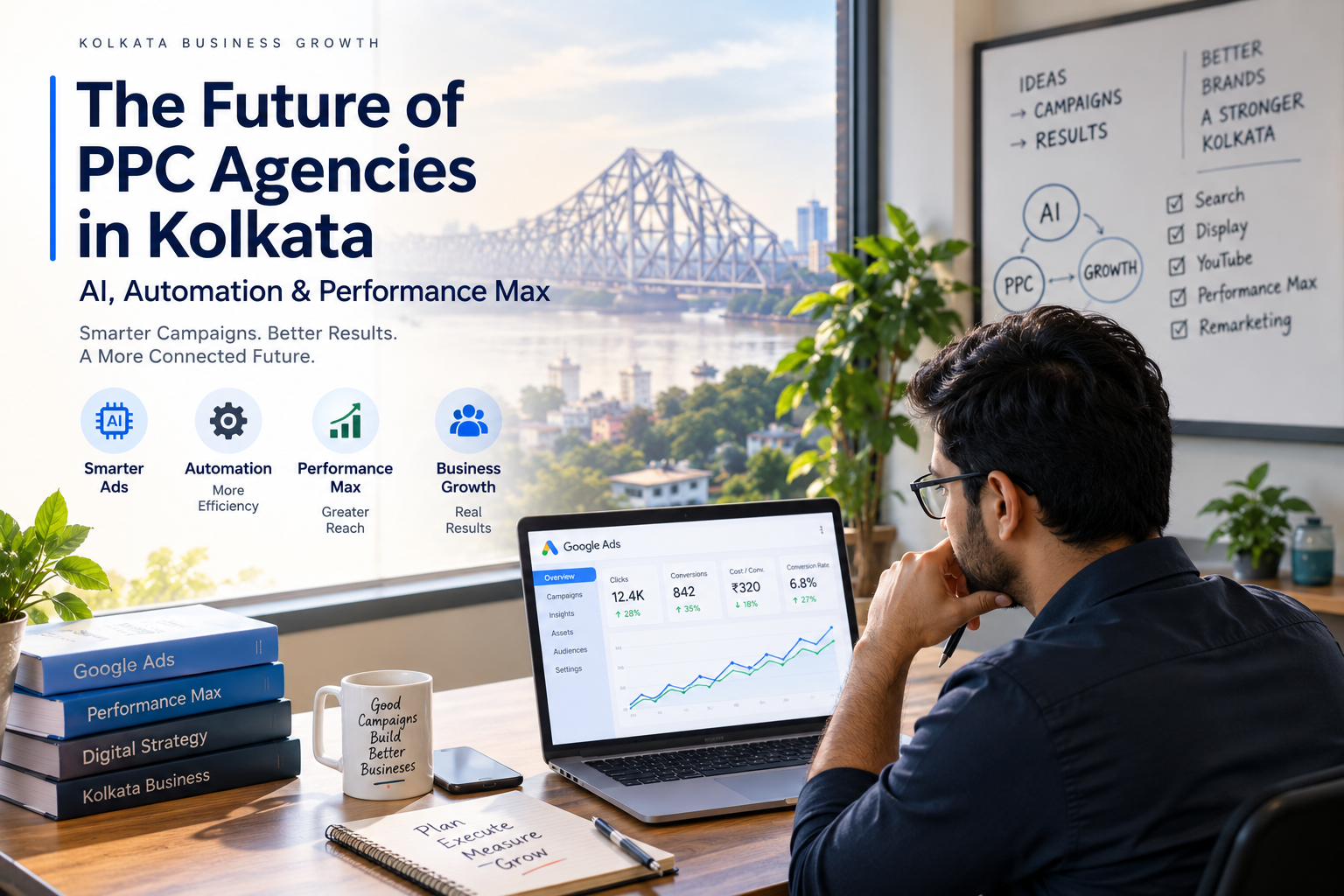
Google Ads is becoming much more automated. AI is involved in more campaign decisions. Performance Max can distribute advertising across several Google properties. Automated bidding can make decisions at a speed no person can match manually.
So naturally, businesses in Kolkata are asking an important question: if Google is doing more of the work, what will a PPC agency actually do in the future?
PPC in Kolkata Is Not What It Was Five Years Ago
If you manage paid advertising for a local business in Kolkata, you can see the change quite clearly.
Clients still want leads and sales, of course. But the campaigns used to get those results are becoming less manual. Google increasingly wants advertisers to give its systems good information and let automation make many of the smaller decisions.
That can be a good thing.
A machine can look at thousands of signals at the same time. It can adjust bids, recognise patterns and react to changes much faster than a person sitting in an account every morning.
But there is a catch.
Automation is only as good as the direction it receives.
If the campaign is tracking the wrong conversion, sends people to a poor landing page or is built around a weak offer, automation can simply become a very efficient way of spending money in the wrong direction.
What AI Is Actually Changing in PPC
AI is often discussed as though it is going to take over advertising overnight. In practice, the change is more gradual.
More parts of campaign management are being assisted by machine learning and automation. Bidding, audience signals, targeting, creative combinations and performance predictions can all involve automated systems.
Bid Decisions
Automated bidding can react to many signals and adjust bids far more frequently than a human manager reasonably could.
Audience Signals
Google can use a wider range of behavioural and contextual signals to find people who may be more likely to convert.
Creative Assistance
Advertisers can increasingly use AI-assisted tools to create and test different combinations of headlines, descriptions and assets.
For a PPC agency, this changes the daily routine. There is less reason to spend hours making tiny manual bid adjustments when the platform can handle that part of the job.
The time saved should not mean doing less work. It should mean doing better work. For businesses considering Google Ads expertise in Kolkata, the important question is how that automation is turned into better campaign decisions.
Performance Max Is a Major Part of This Change
Performance Max has probably created more confusion among advertisers than almost any other recent Google Ads campaign type.
The basic idea is fairly simple: instead of treating Search, YouTube, Display, Discover, Gmail and Maps as completely separate worlds, Performance Max allows Google to use its inventory together and decide where ads may have the best chance of achieving the campaign goal.
For a business, that can open up more opportunities to reach potential customers.
For an agency, however, it changes the job.
You are no longer controlling every little part of the campaign in the same way you might have done with an older account structure. More of the decision-making sits inside Google's systems.
More Reach
A campaign can access multiple Google surfaces instead of relying on one placement.
More Automation
The system can decide where and when to use budget based on its optimisation signals.
More Responsibility
The advertiser has to get the goals, conversion data, creative and landing experience right.
The PPC Manager's Job Is Moving Up the Ladder
This is probably the biggest change for PPC professionals.
When software handles more of the repetitive work, the person managing the account has to bring something else to the table.
Instead of asking only, “What bid should I change today?” a good PPC manager is increasingly asking:
- Are we tracking the right conversion?
- Are these leads actually useful to the business?
- Is the offer strong enough?
- Does the landing page match the ad?
- Are we attracting the right kind of customer?
- Is the cost per lead acceptable after considering lead quality?
- What happens to a lead after it enters the sales process?
Those are not questions an advertising platform can answer properly on its own.
Clicks are becoming easier to automate. Good business decisions are not.
That is where an experienced PPC agency can still make a meaningful difference.
Keywords Still Matter—but the Conversation Has Changed
There is another idea floating around that AI and automation have made keywords irrelevant. I don't think that is the right way to look at it.
Keywords are still useful because they tell us something about what people are looking for. A person searching for “dentist for root canal Kolkata” has a very different intent from someone searching for “how does root canal treatment work”.
The difference is that modern PPC management cannot stop at the keyword.
The agency has to understand the intent behind the search and what happens after the click. That is also why Google Ads lead generation in Kolkata should be measured beyond clicks alone.
Search Intent
What does the person actually want right now?
Lead Quality
Does the enquiry have a realistic chance of becoming a customer?
Business Value
Is the campaign bringing customers who are worth acquiring?
That is a much more useful conversation than simply asking how many keywords are sitting inside the account.
Landing Pages Will Matter More, Not Less
This is one area where I expect good PPC agencies to become more involved.
Imagine spending ₹500 to get someone to click an ad and then sending that person to a slow page with five different offers, no clear headline and a contact form buried at the bottom.
The advertising platform cannot fix that by itself.
For a deeper look at this part of the process, see landing page optimisation for Google Ads leads.
The ad may be doing its job perfectly. The problem is what happens next.
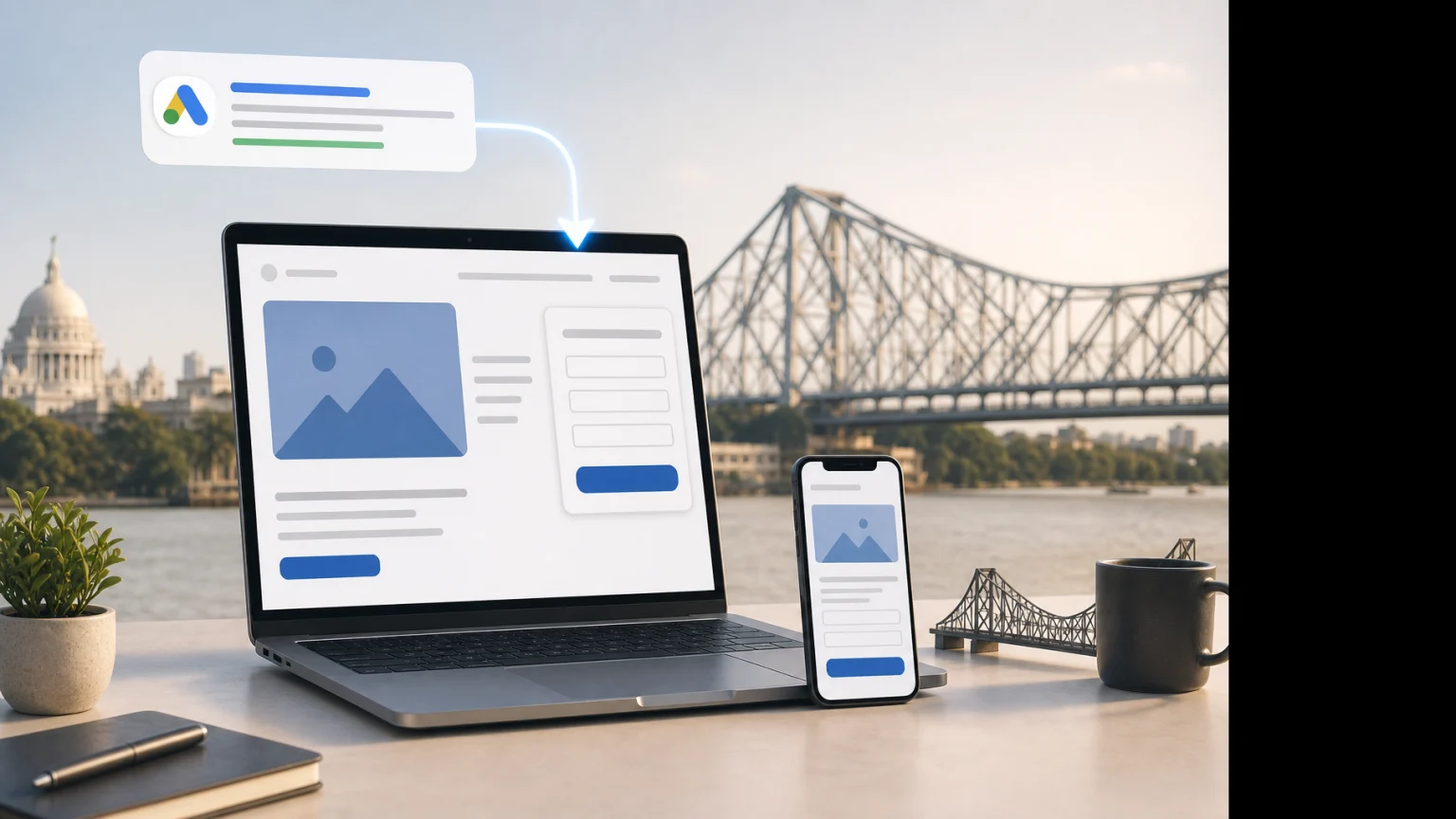
As targeting and bidding become more automated, the difference between an average campaign and a good campaign can increasingly come down to the experience after the click. This is where a well-planned PPC management in Kolkata can connect advertising, landing pages and conversion goals.
- The landing page should match what the person searched for.
- The main offer should be obvious.
- The page should work properly on a mobile phone.
- Phone, WhatsApp or enquiry options should be easy to find where appropriate.
- The form should ask for only what is necessary.
- Conversion tracking should record the action that actually matters.
Lead Quality Will Become More Important for Kolkata Businesses
For many local businesses, especially service businesses, the number of leads can be misleading.
Suppose Campaign A produces 100 enquiries at ₹300 each, but most are irrelevant. Campaign B produces 45 enquiries at ₹550 each, and a large percentage are genuine prospects.
Which campaign is better?
The answer is not automatically Campaign A.
This is why future PPC reporting needs to move beyond cheap clicks and cheap leads. Agencies need to understand what happens to the leads after they are generated.
A healthier way to look at performance is:
Ad spend → Clicks → Enquiries → Qualified leads → Customers → Revenue
The further an agency can connect advertising data to real business outcomes, the more useful its work becomes. For practical campaign measurement, see the discussion of Google Ads lead generation and how enquiry quality should be considered alongside lead volume.
First-Party Data Will Become More Valuable
As advertising platforms become more automated and privacy expectations continue to evolve, businesses will have more reason to make good use of the information they already own.
CRM records, customer lists, qualified leads, purchase information and properly configured conversion data can give advertising systems better signals about what a valuable customer actually looks like.
This is particularly important for businesses where a lead is not the final outcome.
A lead-generation campaign may look successful inside Google Ads, but the business may later discover that only a small percentage of those enquiries were genuine. Connecting advertising with the sales process can give the agency a much clearer picture.
Creative Will Become a Bigger Part of PPC
Automation can make decisions about where to show an ad. It cannot magically create a compelling reason for someone to choose one business over another.
That still comes down to the message.
For example, a generic headline saying “Best digital marketing Services in Kolkata” is not automatically persuasive just because it is shown to the right audience.
The offer, positioning, proof, wording and visual presentation still matter.
The Offer
What are you actually giving the customer a reason to enquire today?
The Message
Does the ad speak to the problem or need that brought the person to Google?
The Proof
Why should someone believe that your business can deliver what the ad promises?
This is one reason I do not see PPC becoming a purely technical job. The more automation takes care of mechanics, the more important the quality of the message becomes.
Will Small PPC Agencies in Kolkata Survive?
Yes—but not all of them will survive in the same form.
An agency whose entire value is “we know how to change bids and add keywords” has a difficult future. Much of that work is already being automated.
A smaller agency that knows a particular industry, understands local customers, builds good landing pages, tracks real conversions and communicates clearly with clients can still be extremely valuable.
In fact, smaller agencies may have an advantage in some cases because they can stay close to the business instead of treating the account like just another number on a dashboard.
What Businesses Should Look for in a PPC Agency
The way businesses choose PPC agencies may need to change too.
Don't judge an agency only by a presentation full of CTR, impressions and screenshots from Google Ads.
Ask practical questions.
- What exactly counts as a conversion for my business?
- How will you measure lead quality?
- What happens if the campaign generates leads but sales do not improve?
- How will you use Performance Max?
- What will you do about the landing page?
- How often will we review actual business results?
- Can you explain the strategy without hiding behind technical language?
A good agency should be comfortable answering these questions.
Automation Does Not Mean “Set It and Forget It”
This is probably the most dangerous misunderstanding about modern PPC.
Someone switches on automated bidding, launches Performance Max and assumes Google will take care of everything.
It doesn't work that way.
Automation still needs a clear goal. It needs useful conversion signals. It needs good creative. It needs enough information to learn from. And someone needs to look at the results and decide whether the results actually make sense for the business.
A campaign can show a beautiful dashboard and still be producing the wrong customers.
AI Will Not Replace Strategy
I think this is where the conversation around AI often becomes too simplistic.
AI is very good at speed, scale and pattern recognition. If there are thousands of data points to process, a machine has obvious advantages.
But a business owner still has to decide what kind of customer they want, what they are willing to pay to acquire that customer, what makes their service different and what the business can realistically handle.
An agency still has to understand the market, the offer and the customer.
AI Is Good At
Processing data, finding patterns, automating repeated decisions and working at scale.
People Are Good At
Understanding context, positioning, customer behaviour, business priorities and creative direction.
The Best Combination
Use AI for scale and speed while keeping human judgement responsible for the bigger decisions.
What the Future of PPC Agencies in Kolkata May Look Like
The agency of the future may have fewer people doing repetitive account maintenance and more people working across strategy, creative, data and conversion optimisation.
A typical team could spend less time asking “Which bid should we change?” and more time asking “Why are these leads not turning into customers?”
That is a much more valuable question.
Strategy
Set the right goals, audience, budget and campaign structure for the business.
Data
Make sure conversion tracking and reporting reflect what actually matters.
Creative
Develop messages and assets that give people a reason to choose the business.
Conversion
Improve landing pages and enquiry processes so paid traffic has somewhere useful to go.
Analysis
Look beyond surface-level metrics and understand lead and customer quality.
Human Judgement
Decide what the platform cannot know about the business, its customers and its priorities.
What This Means for PPC Professionals
If you work in PPC, this is not a reason to panic about AI. It is a reason to broaden your skills.
Knowing Google Ads is still useful. But knowing only the buttons inside Google Ads is becoming less valuable.
The PPC professionals who adapt will understand at least some of the areas around advertising:
- Conversion tracking and analytics
- Landing-page optimisation
- Copywriting and creative strategy
- Customer and market research
- CRM and lead-quality data
- Business economics and customer acquisition cost
- AI-assisted workflows
- How automation actually behaves in modern campaigns
The role is becoming broader, not smaller.
So, What Is the Future of PPC Agencies in Kolkata?
I don't think the future belongs to agencies that promise to “beat the algorithm.”
It belongs to agencies that understand how the algorithm works, know what information to give it and are willing to take responsibility for the business result.
For Kolkata businesses, that means the conversation around Google Ads is likely to become less about manual optimisation and more about the complete acquisition system. Businesses looking for a dedicated Google Ads and PPC specialist in Kolkata can use this broader view when evaluating campaign management.
Conclusions
AI, automation and Performance Max are changing PPC. There is no point pretending otherwise.
Some of the work that once required hours of manual management can now be done by advertising platforms much faster. That is not necessarily bad news for agencies. It gives them a chance to spend more time on the parts of the job that actually require experience and judgement.
For businesses, the lesson is just as important.
Don't hire a PPC agency simply because it knows how to launch a campaign. Look for someone who can understand your customer, build a sensible acquisition strategy, track the right outcomes and use Google's automation without blindly trusting it.
Because at the end of the day, the future of PPC is not about getting more clicks.
It is about using technology intelligently to bring the right people to the business—and turning those opportunities into real growth.
Frequently Asked Questions
Will AI replace PPC agencies?
AI will automate more PPC tasks, but that does not remove the need for strategy, creative thinking, conversion tracking, landing-page optimisation and business judgement. The agency role is changing rather than simply disappearing.
Is Performance Max good for every business?
Performance Max can be useful, but there is no campaign type that is automatically right for every business. The decision should depend on the business goal, conversion data, available creative assets, audience and the type of demand being captured.
Are keywords still important in Google Ads?
Yes. Keywords remain useful for understanding search intent and demand. Modern PPC also relies on broader signals, so keyword management should be part of a larger strategy rather than the entire strategy.
Will PPC become completely automated?
More operational decisions will likely become automated. Businesses will still need people to define goals, provide good data, create strong offers and evaluate whether the results make commercial sense.
What should a business in Kolkata expect from a PPC agency?
A business should expect more than campaign setup. A capable agency should understand the customer journey, conversion tracking, lead quality, landing pages, budget allocation and the business outcome behind the advertising.
Is Google Ads still worth investing in?
It can be, especially when there is clear demand and the business has a strong way to convert that demand into enquiries or sales. The result depends on the market, competition, offer, targeting, creative, landing page, tracking and campaign management.
Ready for the Next Stage of PPC?
The future belongs to businesses that use automation without losing sight of the customer.
AI can help manage the campaign. Strategy still decides where the campaign should go.