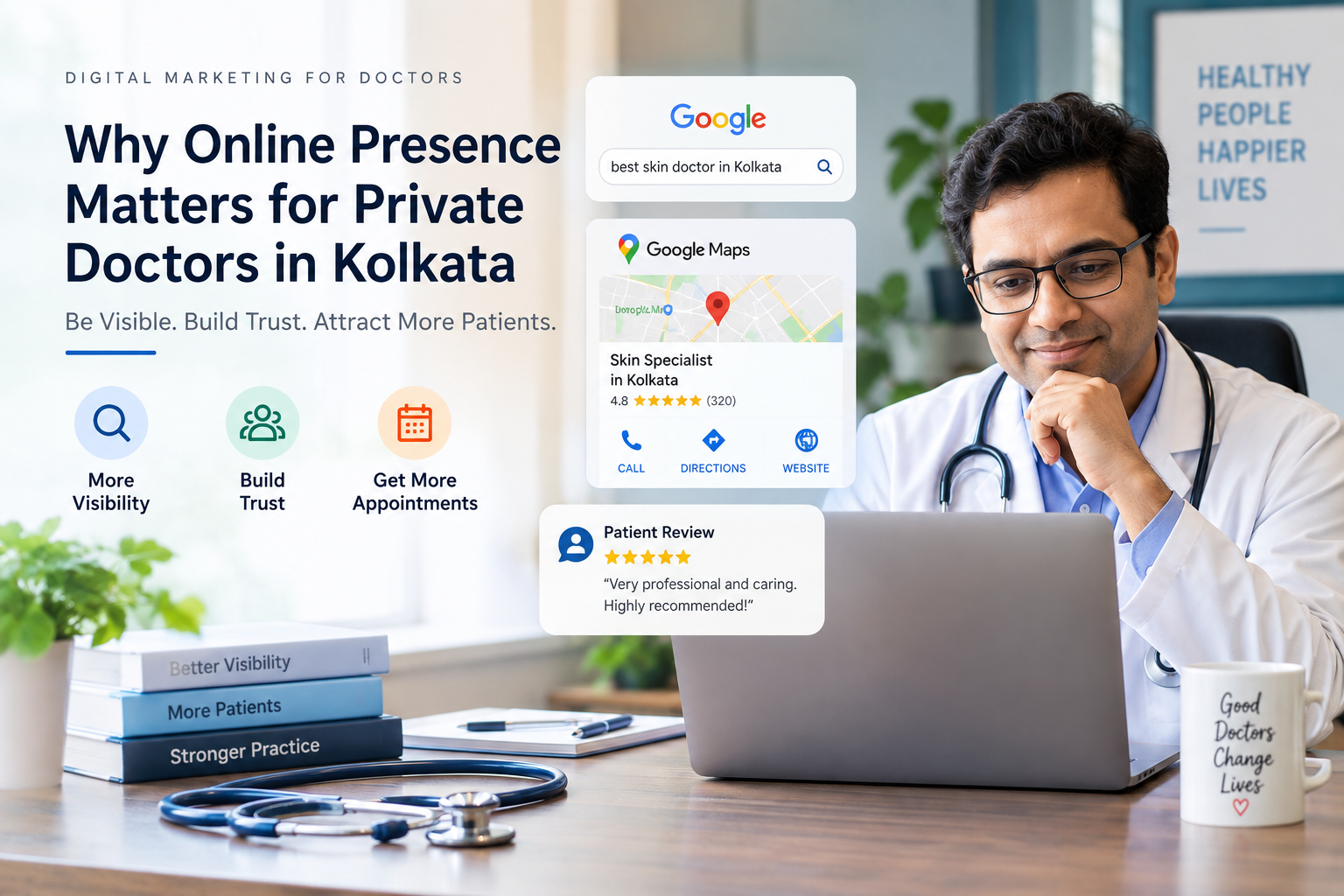
A patient may never call your clinic before checking Google, Maps, reviews and your website. For private doctors in Kolkata, that first online impression can shape whether a patient decides to make contact.
For many private doctors in Kolkata, patient acquisition has traditionally depended on referrals, professional reputation and word of mouth. Those things still matter—but the way patients research a doctor has changed.
Today, a patient may hear a doctor's name from a friend and immediately search for that doctor on Google. Another patient may search "cardiologist near me", "best skin doctor in Kolkata", or a specialty combined with a locality. They may check Google Maps, reviews, the doctor's website, qualifications, services and online content before deciding whether to make an appointment.
Search is also becoming more conversational, with patients increasingly using AI-powered tools and AI search experiences to find and compare information.
That is why a strong online presence is becoming an important part of building a modern private medical practice.
What a Patient Actually Sees Before the First Appointment
A private doctor in Kolkata should not think of online visibility as one website, one Google listing or one advertising campaign. Patients often move between several sources before they decide to contact a practice.
A stronger strategy is to build a connected digital presence across:
- Google Search
- Google Maps and Google Business Profile
- A professional doctor website
- Local SEO
- Educational medical content
- Online reviews and reputation
- Social media where appropriate
- AI-powered search visibility
- Google Ads when paid patient acquisition is appropriate
The objective is not simply to "be online." The objective is to make it easier for the right patient to find, understand, trust and contact your practice.
Why Online Presence Matters More for Private Doctors in 2026–27
The modern patient journey can involve several digital touchpoints before an appointment is booked.
A patient might first search for a medical problem, then look for a specialist, compare several doctors, check reviews, find the clinic on Google Maps and finally visit the doctor's website before calling.
This means that your online presence works as an extension of your professional reputation.
If your practice is difficult to find online, has outdated information, has no professional website or has very little useful information available, another doctor may receive the enquiry simply because their digital presence is easier to discover and evaluate.
Patients Are Searching Google Before Contacting Doctors
Google remains one of the most important discovery channels for local businesses, including medical practices.
Patients can search using combinations of specialty, service, location and intent.
Specialty Searches
"orthopedic doctor in Kolkata", "dermatologist in Kolkata" or "oncologist near me".
Local Searches
"doctor in Salt Lake", "ENT specialist in New Town" or "surgeon near me".
Problem-Based Searches
Patients may search around symptoms, conditions, treatments or procedures before choosing a specialist.
This is where SEO and Local SEO become important.
Google Maps Is Especially Important for Private Practices
For a private doctor, appearing when someone searches for a nearby medical professional can be extremely valuable.
Google Maps and the local search results can help a patient quickly discover:
- Doctor or clinic name
- Location
- Phone number
- Opening hours
- Reviews
- Website
- Photos
- Services
- Directions
A properly maintained Google Business Profile therefore becomes an important part of a doctor's digital presence.
For doctors who want to understand the wider local-search picture, the guide to local SEO and Google Maps visibility in Kolkata explains how these two discovery channels can work together.
Local visibility should not be treated as simply adding a clinic to Google Maps. It should be supported by accurate business information, a relevant website, useful content, genuine reviews and a consistent local presence.
If one part contains outdated or conflicting information, the patient has to work harder to understand the practice.
Your Website Is Your Digital Practice Profile
Many doctors underestimate the importance of having their own professional website.
A third-party directory can provide visibility, but your own website gives you significantly more control over how patients understand your practice.
A good doctor's website should make important information easy to find.
What Should a Doctor's Website Include?
- Doctor's name and specialty
- Qualifications and professional experience
- Areas of expertise
- Conditions and treatments handled
- Clinic locations
- Consultation information
- Contact details
- Appointment enquiry options
- Google Maps location
- Educational medical content
- Frequently asked questions
The website should also be fast, mobile-friendly and easy to navigate. A useful companion to this is the guide on website development in Kolkata, particularly when an older doctor website needs a structural or usability upgrade.
A patient should not have to search through several pages just to find the clinic address or appointment contact information.
SEO Helps Patients Find Your Practice Organically
Having a website does not automatically mean patients will find it.
SEO helps search engines understand what your website is about and which searches it may be relevant for.
For a Kolkata doctor, this could involve building visibility around appropriate combinations of:
- Medical specialty
- Conditions
- Treatments
- Procedures
- Doctor-related searches
- Kolkata
- Relevant neighbourhoods and localities
A strong SEO strategy should focus on useful information and genuine search intent rather than simply repeating keywords. For the broader principles behind this approach, see the guide to SEO for small businesses in Kolkata.
Local SEO and Organic SEO Work Together
Local SEO and traditional organic SEO are related but serve different discovery opportunities.
Google Maps
Helps patients discover your practice through local and nearby searches.
Organic Search
Helps your website appear for relevant informational, specialty and treatment-related searches.
Your Website
Provides the detailed information patients need before deciding whether to contact you.
For a private practice, building all three together can create a much stronger search presence than depending on only one channel.
Online Reviews Are Part of Your Digital Reputation
When choosing between several doctors, patients may look at reviews before making an appointment.
Reviews cannot replace medical expertise, but they can influence how confidently a prospective patient evaluates a practice.
Doctors should therefore pay attention to:
- Maintaining an accurate Google Business Profile
- Encouraging genuine patient feedback where appropriate
- Responding professionally to reviews
- Keeping practice information accurate
- Monitoring their online reputation
Reviews should always be genuine. Your broader SEO and digital visibility strategy should never depend on fake reviews or misleading claims.
Medical Content Builds Digital Trust
A doctor's website should not exist only as an online visiting card.
Useful educational content can help patients understand a condition, treatment or procedure before they contact the practice.
Examples include:
- When should you consult a specialist?
- What symptoms should not be ignored?
- What happens during a particular procedure?
- What questions should you ask your doctor?
- What is the difference between two treatment options?
- When is surgery considered?
This type of content can also create additional opportunities to appear in relevant search results.
For medical websites, content should be created carefully and should not make unsupported medical promises or replace professional medical advice.
AI Search Is Creating Another Visibility Opportunity
Search behaviour is expanding beyond traditional blue-link results.
People can increasingly ask conversational questions through AI-powered search experiences and assistants.
That creates another reason for doctors to build a strong, trustworthy and clearly structured digital presence.
AI systems need reliable information to understand entities, services, expertise and context. A doctor with a clear website, consistent professional information, useful content and a credible digital footprint has a stronger foundation for being understood across modern search experiences.
This does not mean that anyone can guarantee that a particular doctor will be recommended by an AI system. AI search visibility is an evolving area and should be approached as part of a broader search strategy.
- Who the doctor is
- Specialty and services
- Location and practice details
- Clear, useful information
- Trust
- Relevant expertise
- Accurate information
- A clear next step
AI visibility is still evolving. The practical foundation remains a clear, trustworthy and consistent digital presence.
Why Your Professional Information Must Be Consistent
Imagine that your website lists one clinic address, Google shows another, and an online directory has an old telephone number.
That creates unnecessary confusion.
Your important business information should be consistent wherever patients may encounter your practice.
This includes:
- Doctor name
- Specialty
- Clinic name
- Address
- Phone number
- Website
- Consultation information
- Professional information
Consistency helps create a clearer digital identity for both patients and search systems.
Social Media Can Support Your Professional Brand
Not every doctor needs to become a social media influencer.
However, selected social platforms can support professional visibility when used appropriately.
Doctors can use social media to share:
- Educational health information
- Practice updates
- General awareness content
- Short educational videos
- Links to useful website resources
- Professional achievements and updates
The emphasis should remain on professional communication and patient education rather than exaggerated promotional claims.
Google ads Can Provide Faster Visibility
SEO and Local SEO generally require time to build. Paid advertising can provide another route to visibility when a practice has a clear service, appropriate targeting and a suitable conversion process.
For example, a doctor may use search advertising around relevant services or appointment-related searches.
However, paid advertising should not replace long-term organic visibility. When paid acquisition is appropriate, doctors can also review the approach outlined on the Google Ads service page before deciding how it fits into the wider patient-acquisition system.
A stronger strategy is often to combine:
- SEO
- Google Maps visibility
- Professional website
- Useful content
- Reputation management
- Paid campaigns where appropriate
The Online Presence a Private Doctor Should Build in 2026–27
A modern private practice can think of its online presence as a connected system rather than a collection of separate accounts.
01. Website
Your central source of professional and practice information.
02. Google Business Profile
Your local discovery and Google Maps presence.
03. SEO
Your long-term organic search visibility.
04. Content
Useful information that answers patient search questions.
05. Reputation
Genuine reviews and consistent professional information.
06. AI Search Visibility
A developing opportunity to make your professional information easier for AI-powered search systems to understand.
Why Kolkata Makes Local Visibility Important
Kolkata is not one single local-search market. A patient looking for a specialist in Salt Lake may behave very differently from someone searching around Garia, Ballygunge or New Town. The specialty, clinic location and the reason for the search all change the context.
A doctor therefore may not need to compete for every healthcare search in the city. A more useful objective is to become visible for the searches that genuinely match the practice.
The more practical objective is to become visible for the searches that are actually relevant to the doctor's specialty, location and services.
For example, a doctor practicing in Salt Lake may want visibility around relevant Salt Lake searches rather than trying to appear for every medical search in Kolkata.
The same principle can apply to New Town, Behala, Ballygunge, Garia, Dum Dum, Park Street, Jadavpur, Tollygunge and other areas.
Patients Need More Than Just a Doctor's Name
Suppose someone searches for your name.
What do they find?
- A professional website?
- Accurate qualifications?
- Your specialty and expertise?
- Clinic location?
- Google Maps listing?
- Useful medical information?
- Genuine reviews?
- Easy contact or appointment options?
These details collectively shape the patient's first digital impression.
That is why online presence should be treated as part of practice communication—not simply advertising.
What a Strong Doctor Digital Strategy Should Focus On
A good digital strategy should begin with the doctor's actual business objectives.
For example:
- Increase local visibility
- Generate more relevant enquiries
- Build awareness for a specialty
- Improve Google Maps presence
- Build organic search visibility
- Educate potential patients
- Improve website conversions
- Strengthen digital reputation
The strategy should then connect the appropriate channels to those objectives.
How Long Does It Take to Build an Online Presence?
There is no universal timeline for SEO or local search visibility.
Results can vary depending on competition, specialty, location, website quality, existing authority, content, Google Business Profile history and the amount of work being implemented.
Some improvements can happen relatively quickly, such as correcting inaccurate information, improving a website's user experience or properly setting up a business profile.
Organic search visibility generally requires consistent work over a longer period.
The important point is to treat digital marketing and SEO as a process rather than expecting one campaign to permanently solve online visibility.
Common Online Presence Mistakes Doctors Should Avoid
- Having no professional website
- Using an outdated website
- Ignoring Google Maps
- Leaving incorrect clinic information online
- Publishing very little useful content
- Ignoring reviews
- Using fake reviews
- Making exaggerated medical claims
- Depending completely on one platform
- Running advertising without a proper conversion system
Online Presence Is Not About Becoming Famous
A private doctor does not necessarily need millions of social media followers.
The objective is much simpler.
When someone who genuinely needs your expertise searches for a doctor, your practice should be easy to discover and easy to understand.
That means being visible in the right places with accurate information and a professional presentation.
Why Private Doctors Should Start Before They Need More Patients
Building digital authority takes time.
Waiting until a practice urgently needs more enquiries can make the process unnecessarily difficult.
A stronger approach is to gradually build the foundation:
- Create or improve the professional website.
- Optimise the Google Business Profile.
- Build local and organic SEO.
- Publish useful medical content.
- Develop a genuine review and reputation strategy.
- Improve appointment and enquiry conversion.
- Explore paid advertising where appropriate.
- Build visibility across emerging AI search experiences.
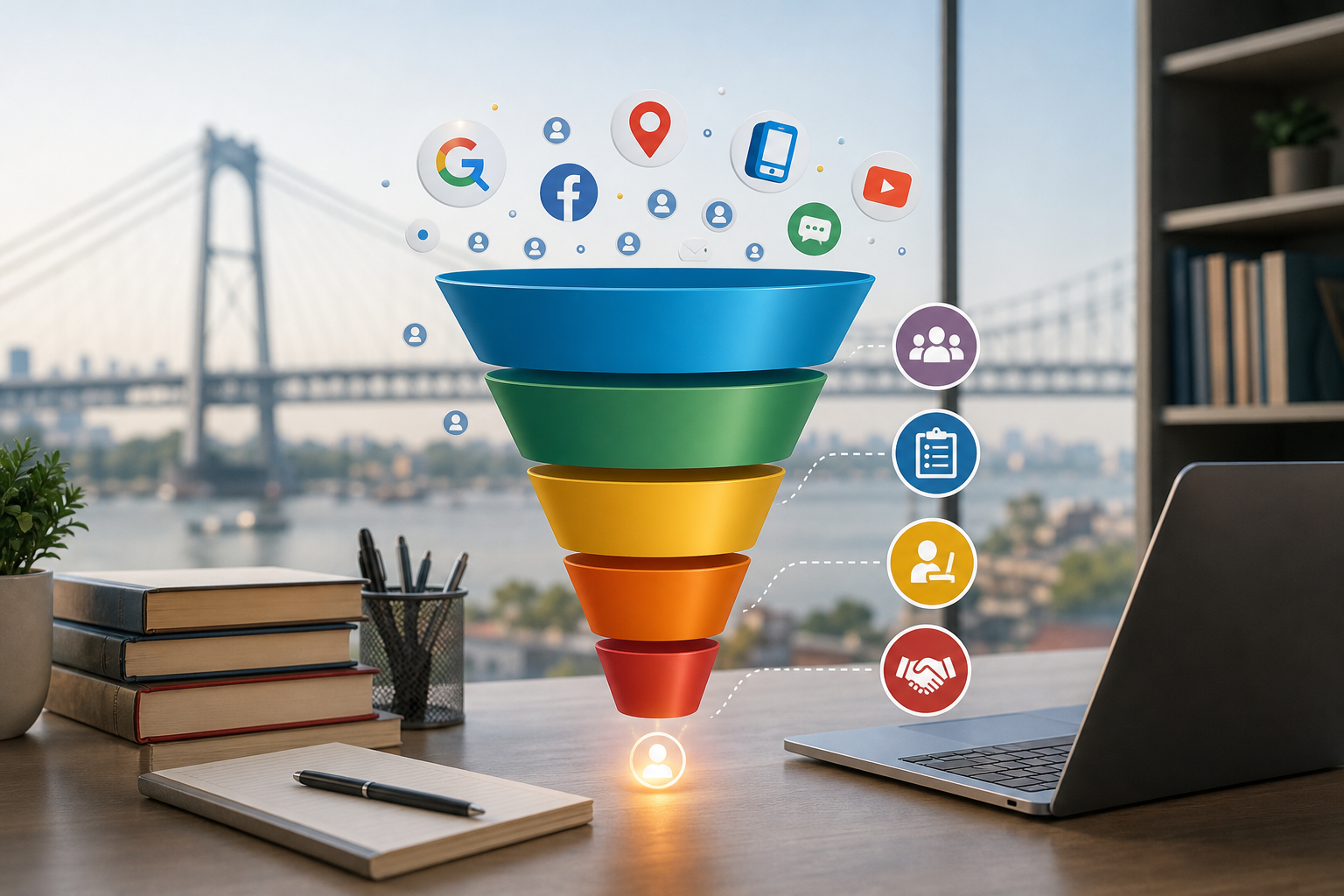
More traffic is not the finish line. The useful outcome is helping the right patient move naturally from discovery to action.
Conclusion
A doctor's online presence should not be judged by how many platforms the practice appears on. The more useful question is much simpler: when the right patient starts looking, can they quickly find enough accurate information to feel confident about taking the next step?
For a private practice in Kolkata, that usually means getting the fundamentals right first—an informative website, a properly maintained Google Business Profile, relevant organic visibility, genuine reviews, useful medical content and a clear path to contact or book an appointment.
Paid Google Ads and newer AI-powered search experiences can add further opportunities, but they work best when the underlying digital presence is already clear and trustworthy. No single channel can substitute for that foundation.
The practical goal is not to make a doctor famous online. It is to make the practice discoverable for relevant searches, credible when patients investigate it, and easy to contact when they are ready. That is a much more meaningful definition of online presence for a private doctor—and it is the standard worth building toward as search behaviour continues to change.
Frequently Asked Questions
Does every private doctor need a website?
Not every doctor needs a complex website, but a professional website can provide an important central source of information about the doctor's qualifications, specialty, services, location and appointment options.
Is Google Maps important for doctors?
Yes. For locally focused practices, Google Maps and Google Business Profile can help patients discover the practice when searching for nearby doctors and healthcare services.
Should doctors invest in SEO?
SEO can be valuable for doctors who want to build long-term organic visibility. The strategy should focus on relevant patient searches, useful content, technical quality and local visibility.
Do doctors need social media?
Social media can support professional visibility, but it does not need to be the centre of every doctor's marketing strategy. The appropriate channels depend on the doctor's specialty, audience and objectives.
Can AI SEO guarantee that a doctor will appear in AI answers?
No responsible SEO strategy should guarantee placement in AI-generated answers. AI search visibility is evolving. The practical approach is to build clear, trustworthy and authoritative digital information that can be understood across modern search systems.
What is the most important first step?
Start by auditing your existing digital presence. Check what patients see when they search your name, specialty and location. Then identify the biggest gaps across your website, Google Business Profile, SEO, reviews and patient enquiry process.
Start With What Patients See Today
If you are a private doctor in Kolkata, start by searching your own name, specialty and clinic location exactly as a patient would. Look at the website, Google Maps listing, reviews, search results and the ease of making contact. The gaps you find there are usually a more useful starting point than simply adding another marketing channel.
The goal is not simply more traffic. It is a clearer digital presence that helps the right patient find the practice, understand it and decide what to do next.